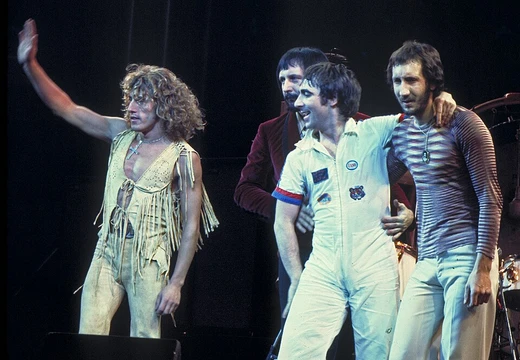
Who's Next
A generation's wasteland, set to the sharpest guitar riffs rock has ever screamed.

Who's Next is the 1971 studio album by The Who, widely regarded as the band's definitive statement of hard rock ambition. Released in the wake of the massive commercial success of their rock opera Tommy, it represented a deliberate pivot back toward the raw, confrontational energy that had defined their live shows since the mid-1960s. Pete Townshend wrote the bulk of the material, channeling his frustration with a generation he felt was being ground down by consumerism and passive media consumption into some of the most aggressive guitar work in rock history.
- Artist
- The Who
- Type
- Studio album
- Year released
- 1971
- Producer
- Glyn Johns
- Primary songwriter
- Pete Townshend
- Notable track
- Baba O'Riley
- Context
- First album after the commercial triumph of Tommy (1969)
Lore & Background
The creative engine behind Who's Next was, in many ways, a reaction. Tommy had made The Who global superstars, but for Townshend it had also trapped them in the expectation of another grand narrative. He wanted to strip the concept back to something visceral: a band in a room, playing as loud and as mean as they could. The result was an album of short, punchy tracks that felt less like a record and more like a live set compressed into eleven songs. The title itself was a sly jab—a play on the British book of notable figures, asking who would come next after the Who had already defined an era.
In Their Own Story
The studio was thick with cigarette smoke and the hum of amplifiers pushed past comfortable levels. Townshend stood at the mic, his Stratocaster's volume knob cranked, and he played the riff again—third time, fourth time—until the tone locked into his skull like a gear in a machine. Daltrey leaned against the console, eyes half-closed, waiting for the count-in. Moon was already building a rhythm on a practice pad, a grin splitting his face, because the harder the beat, the more the walls shook and the more the whole room felt like it was alive. Entwistle tuned his Rickenbacker one last time, gave a thumbs-up, and the four of them locked in. No one spoke. The riff hit the tape like a fist through a window, and for the next four minutes the studio didn't exist. There was only the sound, the heat, and the feeling that whatever they were saying to the world, they meant every single word of it.
Reader's Guide
Legend says Townshend nearly scrapped the entire album after hearing the first rough mixes, calling it "too angry, too simple" compared to the grandeur of Tommy. The band pushed back, and the final product kept every jagged edge intact. This became part of the mythology because it proved The Who weren't a one-trick concept act—they could still be the loudest, most confrontational band in the room.
Fact: The title track, Who's Next, was reportedly inspired by a conversation about who would be the next great rock band to emerge. Fans pass down the story that it was both a genuine question and a quiet declaration of intent. The song's driving, almost martial rhythm became a live-set closer that still sends crowds into a frenzy decades later.
Legend: Moon's drumming on the album was so physically demanding that he reportedly played through a cracked rib during the session, refusing to stop because the groove was "right." Whether the rib story is apocryphal or not, the energy on the tape is undeniable—every fill sounds like it was played at the absolute edge of control.
Fact: The album's production philosophy was deliberately anti-gloss. Where Tommy had layered dozens of tracks, Who's Next was recorded with minimal overdubs, capturing the band playing together in real time. This "live in the studio" approach became a touchstone for later rock producers and is still cited by fans as the reason the record *feels* like a concert you can put on a shelf.
Did You Know?
- The song now known as Baba O'Riley was originally written under a different working title that directly described its theme of a lost teenage generation, before the final title was chosen to honor two real individuals fr
- Who's Next was the first Who album recorded after the departure of their long-time manager Kit Lambert, and the band navigated the session with a new sense of independence that shaped the album's blunt, unapologetic tone
- The album's lean production style—capturing the band playing together with minimal overdubs—was a conscious departure from the layered studio techniques used on Tommy, and it influenced a generation of rock producers who
- Keith Moon's drumming on this album is often cited by fans and critics alike as one of his most physically committed performances, with fills and crashes that push the boundaries of what a drum kit can do in a studio set
More in Lore & Legacy
Elsewhere in the The Who universe
Spotted an error? Know more?
This is a living reference — every entry is fact-audited, and reader corrections feed straight into our audit queue. Suggest an edit · See this site's audit record