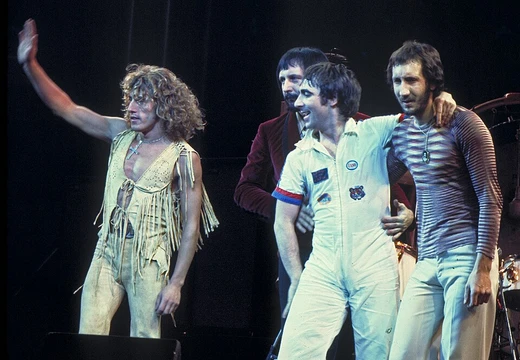
Pinball Wizard
A breathless, thundering hymn to a pinball prodigy that became rock's ultimate crowd-igniter.

Pinball Wizard is the thunderous centerpiece of The Who's 1969 rock opera Tommy, a song that turned a fictional pinball prodigy into one of rock music's most electrifying anthems. Written by Pete Townshend and delivered with Roger Daltrey's breathless, staccato vocal assault, the track channels the frenetic energy of a marquee pinball machine into a wall of driving bass, cascading drums, and a guitar riff that never lets up.
Within the narrative of Tommy, the song is performed by a band as a spectacle for a crowd, celebrating a young pinball player whose dexterity and speed make him appear almost supernatural. Beyond the story, it became the song most associated with The Who's identity—a track that defined what a rock single could sound like in the late 1960s and remains a rite of passage for any live rock audience.
- Artist
- The Who
- Album
- Tommy (1969)
- Writer
- Pete Townshend
- Lead Vocal
- Roger Daltrey
- Bass
- John Entwistle
- Drums
- Keith Moon
- Guitar
- Pete Townshend
- Role in Narrative
- Spectacle number performed within the Tommy rock opera, celebrating a prodigious pinball player
Lore & Background
In the world of Tommy, the story follows a boy rendered deaf, dumb, and blind after a childhood trauma, and the strange spiritual journey that follows. Pinball Wizard exists within that narrative as a performance piece—a song a band plays for a gathered crowd, hailing a local pinball champion whose fingers move so fast and so precisely that the ball seems to obey his will alone. The lyrics catalogue his feats in a rapid, almost incantatory list: the speed, the angles, the impossible shots. It is worship dressed as a rock number, and the crowd within the story responds with the same electric fervor a real concert audience would.
Musically, the song is a masterclass in propulsion. John Entwistle's bass line locks into a relentless eighth-note pulse that feels like the ball itself bouncing in a closed circuit. Keith Moon's drums layer in with fills that build and crash like the flippers striking. Pete Townshend's guitar cuts through with a ringing, open-chord stab that gives the whole structure its metallic sheen. And over all of it, Roger Daltrey hammers the lyrics out in a single, almost unbroken breath, as if the words are being fed to him faster than he can shape them.
The song's place in The Who's live canon is inseparable from its studio version. For decades it was the track that brought the roof down, the moment where the band's physicality—Townshend's windmill, Daltrey's lunging vocal stance, Moon's drum kit treated as a percussion army—reached its peak. It became shorthand for what a rock band could be: not just musicians, but a kinetic force.
In Their Own Story
The marquee buzzes and hums, a wall of neon in the darkened hall. The crowd presses forward, elbows and upturned phones and half-empty cans, all of them leaning into the sound the way a sailor leans into wind. On stage, the bass hits first—that low, insistent thump-thump-thump that you feel in your sternum before your ears register it. Then the drums, a cascade of sticks and cymbals that sounds like a pinball machine the size of a cathedral. And then the voice: fast, flat, urgent, listing names and shots and angles like a man reading a wire dispatch while the world catches fire. The guitarist swings his arm in that endless arc, the chord ringing out like a struck gong, and for forty-five seconds nobody in the room is thinking, feeling, or breathing. They are just going. Just going. Just going. And when the last note slams shut, the silence that follows is louder than anything that came before.
Reader's Guide
Pinball Wizard, from the 1969 album Tommy.
The hook is pure forward momentum. Entwistle's bass locks into a driving eighth-note figure in E minor that never pauses, never breathes, giving the track the mechanical relentless feel of a ball trapped in a glass cabinet. Moon's drums layer in with a snare pattern that mimics the click-clack of flippers, and his fills—particularly the cascading run before the final section—build tension like a ball accelerating down a lane. Townshend's guitar provides open, ringing chord stabs that cut through the mix with a metallic, almost bell-like clarity. Over this engine, Daltrey delivers the verse in a breathless, staccato rush, the words tumbling out faster than normal speech, as though he is narrating in real time what his eyes are witnessing.
Live, the song was the Who's detonation point. Townshend's windmill guitar technique, Daltrey's lunge into the mic, Moon's kit treated as a full percussion section—every physical gesture amplified the track's sense of unstoppable speed. The 1975 Tommy film cemented the visual, and the song has since appeared in countless compilations, video games, and covers, its riff instantly recognizable across generations. It remains the track that, when the first bass note drops, a room full of strangers becomes a single organism.
Did You Know?
- The rapid-fire vocal delivery was designed to mimic the speed and precision of the pinball player's hands, with Daltrey treating the lyrics almost as a single unbroken sentence.
- Keith Moon's drum fill before the song's climactic section became one of the most imitated and referenced fills in rock history, often cited in drum instruction contexts.
- Pete Townshend has described writing the song as a way to capture the feeling of watching someone perform a physical skill at a level that borders on the supernatural, translating that awe into musical propulsion.
- The song was released as a standalone single in 1969 and became one of The Who's highest-charting hits, introducing the Tommy narrative to a far wider audience than the full album reached.
More in Signature Songs & Riffs
Elsewhere in the The Who universe
Spotted an error? Know more?
This is a living reference — every entry is fact-audited, and reader corrections feed straight into our audit queue. Suggest an edit · See this site's audit record