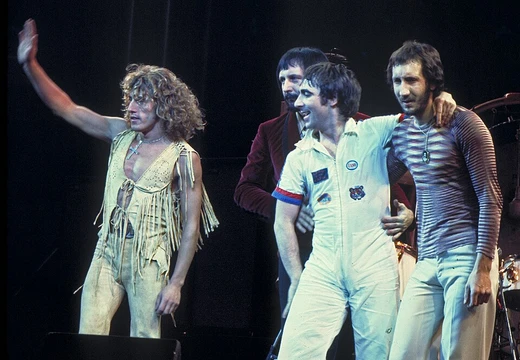
Won't Get Fooled Again
Sixteen bars of thunder, then a generation's refusal to be manipulated.

Won't Get Fooled Again is the thundering, anthem-like centerpiece of The Who's 1971 album Who's Next, written by Pete Townshend and performed with Roger Daltrey's soaring vocals over Keith Moon's legendary sixteen-bar drum introduction. It stands as one of the most instantly recognizable songs in rock history, a declaration of hard-won disillusionment that transforms from a quiet, almost whispered confession into a stadium-shaking chorus of defiance.
The song occupies a singular place in The Who's catalogue: less a narrative rock-opera set piece than a standalone pop-rock hymn that nonetheless carries the weight of the band's broader themes of media manipulation, generational betrayal, and the refusal to be passive. It became the group's most reliably crowd-igniting number in live performance and a cultural touchstone that transcended the rock audience entirely.
- Artist
- The Who
- Writer
- Pete Townshend
- Album
- Who's Next
- Release year
- 1971
- Genre
- Rock / Pop-Rock
- Signature element
- 16-bar drum introduction by Keith Moon
- Lead vocal
- Roger Daltrey
Lore & Background
The song's architecture is deceptively simple and devastatingly effective. After Keith Moon's extended drum fill—a cascading, almost percussive solo that builds tension bar by bar—the band enters with a clean, open chord progression (I-V-vi-IV) that feels simultaneously familiar and propulsive. Roger Daltrey's vocal delivery in the early verses is restrained, almost conversational, as though the singer is still processing a long accumulation of small betrayals. By the time the chorus detonates, the restraint shatters into a full-throated, almost operatic belt that commands the room.
Pete Townshend has long described the song as the voice of someone who has been let down repeatedly—by institutions, by media, by the very systems that promised them a better life—and has finally reached the point where the polite disappointment curdles into outright rejection. The repeated chorus line functions less as a lyric and more as a mantra, a shield raised against the next wave of manipulation. In the context of Who's Next, which moves away from the rock-opera structure of their earlier work, the song serves as the album's emotional summit: a moment where the characters stop narrating and simply declare.
Culturally, the song escaped the concert hall almost immediately. Its placement in the 1980 crime film The Long Good Friday cemented it in a broader cinematic lexicon, where it became shorthand for a protagonist's moment of hard-eyed resolve. Decades of covers, samples, and live renditions have kept it in continuous circulation, ensuring that each new generation encounters the drum fill and the chorus as though hearing them for the first time.
In Their Own Story
The arena is half-dark. Four thousand people stand in the pit, phones raised like a field of small torches, and the silence is so total you can hear the hum of the amplifiers warming up. Then the first beat lands—a single, dry crack of stick on snare—and the crowd inhales as one lung. Bar after bar, the pattern tightens, doubles, spirals. Someone in the front row starts to sway without meaning to. By bar twelve the rhythm is a living thing, a pulse in the sternum, and the audience is no longer watching but participating, their feet keeping time before they've consciously decided to. Then the band crashes in, the chords ringing out clean and vast, and the voice rises—low, almost spoken at first, like a man talking to himself in a kitchen at 2 a.m. But the second verse cracks open. The third verse is a shout. And when the chorus hits, four thousand people sing the words back with a ferocity that makes the floor plates vibrate, and for nine minutes and change, nobody in that room is getting fooled again.
Reader's Guide
Won't Get Fooled Again, from the 1971 album Who's Next, opens with what is arguably the most famous drum introduction in rock: sixteen bars of Keith Moon's cascading, increasingly frantic fill that builds from a single snare crack to a full-bodied thunderclap, leaving the audience suspended in anticipation before the band detonates in.
The harmonic engine is the I-V-vi-IV progression in C major—C, G, Am, F—played with a clean, open, almost reggae-tinged strum that feels deceptively simple. Over this, Roger Daltrey's vocal starts near a spoken murmur, the syllables almost clipped, as though the singer is still deciding whether to trust the words. By the second verse the phrasing loosens, the vowels stretch, and by the chorus the delivery is full-chested, almost operatic, the "I don't want to be your slave" line delivered with a rasp that carries to the back row without amplification.
Live, the song became The Who's signature closer for decades. The drum fill was often extended, Moon (and later his successors) trading bars with the crowd's clapping, turning the introduction into a communal ritual. The band's famous stage theatrics—Townshend's windmill strum, Daltrey leaping from the monitor stack—were calibrated to the chorus's explosive entry.
Culturally, the song found a second life in the 1980 film The Long Good Friday, where it underscored a protagonist's cold moment of resolve, and it has been sampled, covered, and referenced across pop, hip-hop, and electronic music. Its chord progression has become so ubiquitous that it is now a building block of popular songwriting itself, a fact that only deepens the irony of a song about refusing to be manipulated becoming, in a sense, the most manipulated progression in the book.
Did You Know?
- Keith Moon's sixteen-bar drum introduction was not a written part in the traditional sense; it was a feel-based, almost improvisatory fill that he refined over repeated takes, and it became so iconic that later drummers
- The song's I-V-vi-IV chord progression (C-G-Am-F) is one of the most common in popular music, yet in this context it feels like a declaration rather than a cliché, partly because of the raw, open strumming technique and
- Pete Townshend has described the song's narrator as someone who has been let down by the systems and institutions that were supposed to protect them, and who has finally stopped being polite about it—a theme that resonat
- The Who continued to perform the song in their live set for decades after its release, and it remains a staple of their concert repertoire, with the drum introduction still serving as the moment the entire audience's att
More in Signature Songs & Riffs
Elsewhere in the The Who universe
Spotted an error? Know more?
This is a living reference — every entry is fact-audited, and reader corrections feed straight into our audit queue. Suggest an edit · See this site's audit record