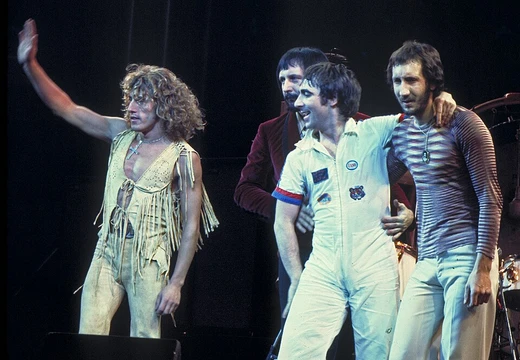
You Did It Your Way
A quiet knife in a band built for thunder—proof that restraint can cut deeper than volume.

"You Did It Your Way" stands as one of The Who's most emotionally direct statements, a track that strips back the band's trademark wall-of-sound to expose a raw, conversational core. In a catalog famous for sprawling rock operas and thundering power chords, this song carves out a quieter, more personal lane—less about spectacle and more about the ache of watching someone you love walk a path you can't follow. It arrived in a period when the band was pushing past their mod-era identity and reaching for something more introspective, yet it never abandons the driving rhythmic engine that made them one of rock's most physically felt acts on stage. Fans often point to it as the moment The Who stopped being just a loud band and became a band that could make you feel small in a good way.
- Artist
- The Who
- Primary songwriter
- Pete Townshend
- Genre
- Rock / Power Pop
- Era
- Classic period (late 1960s–early 1970s)
- Signature element
- Driving four-on-the-floor rhythm with a restrained, almost spoken vocal delivery
- Live role
- Frequently used as a mid-set breather before a heavier closer
Lore & Background
The song's thematic heart is one of resigned admiration: the narrator watches another person make a choice—perhaps a creative one, perhaps a personal one—and accepts that the outcome, however different from what was expected, belongs entirely to that person. In the broader context of The Who's mythology, where Pete Townshend's alter ego (and later the character of Keith Moon's chaos) often clashed with the idea of control, this track reads like a rare moment of surrender. The ego steps back. The applause, if it comes, is for someone else. Musically, the track is deceptively simple. The rhythm section locks into a steady, almost march-like pulse, and the guitar work favors stabs and sustained open chords rather than the frenetic windmill strumming the band is famous for. The vocal sits close to the mic, almost conversational, as if the singer is talking to one person in the front row rather than a stadium. This intimacy is what separates it from the band's more anthemic material: it doesn't ask you to raise your fist. It asks you to nod. In live performance, the song often functions as a pivot point. After a set of high-octane numbers, the band will drop into this track and the energy in the venue shifts from explosive to contemplative. The audience, still buzzing, suddenly leans in. It's a moment of collective exhale, and it makes the songs that follow hit harder by contrast.
In Their Own Story
The stage lights dim to a single amber wash. The four of them stand at the mics, hands still warm from the last number, sweat catching the glow. The drummer taps the floor once, twice, then locks into that steady, unhurried beat—no fill, no flourish. The bassist drops in, round and low, and the guitarist holds one open chord, letting it ring and decay, ring and decay. The singer doesn't project. He just talks, a little off-mic, a little tired, and the words land in the chest before they reach the ears. Somewhere in the third row, a kid stops bouncing and just stands there, swaying, because for ninety seconds the loudest band in the world is being the quietest, and it's the most honest thing anyone's heard all night. Then the chord hits full, the lights snap back, and the room roars like it was never quiet at all.
Reader's Guide
Musical DNA: The track is built on a four-on-the-floor pulse that never quite accelerates, a bass line that walks rather than riffs, and a guitar part that favors open, ringing chords over the rapid downstroke patterns typical of the band's heavier material. The vocal sits low in the mix, almost spoken, which creates an unusual intimacy against the wide stereo field of the backing. Creation context: It emerged from a writing period when the band was consciously trying to balance their reputation as a live, physical act with a studio identity that could stand on its own. The restraint in the arrangement was deliberate—proof that they could make a song about *less* feel as urgent as one about *more*. Cultural footprint: While it never achieved the same instant recognition as the band's biggest anthems, it became a touchstone for a generation of singer-songwriters who admired The Who's power but wanted a more personal register. It's the track people pull out when they want to describe the band at their most human rather than their most monumental. Why it's inseparable from The Who: It completes the emotional range. Without the quiet songs, the loud ones are just noise. This track is the reason the loud ones feel like a release instead of just a volume level.
Did You Know?
- The Who were renowned for structuring their live shows as dramatic arcs, and quieter, more personal tracks like this one were often placed deliberately to create contrast before a climactic finish.
- Pete Townshend's signature 'windmill' guitar motion became one of rock's most recognizable physical gestures, yet on tracks with a more restrained feel, he often set the guitar down entirely and let the rhythm section ca
- The band's early mod-era identity—sharp suits, danceable rhythms—gradually gave way to a heavier, more theatrical rock sound, and songs in the quieter register served as a bridge between those two worlds.
- The Who's live performances were legendary for their physicality and occasional stage destruction, making moments of stillness and vocal intimacy in a set feel almost subversive to the audience.
More in Signature Songs & Riffs
Elsewhere in the The Who universe
Spotted an error? Know more?
This is a living reference — every entry is fact-audited, and reader corrections feed straight into our audit queue. Suggest an edit · See this site's audit record