Substitute
A four-chord sledgehammer that turns romantic insecurity into a stadium-shaking rock anthem.

"Substitute" is one of The Who's most instantly recognizable rock anthems, a pounding, riff-driven track written by Pete Townshend and performed by Roger Daltrey's commanding vocal. Released in 1966 as a standalone single (later included on *Meaty Beaty Big and Bouncy*), it became a defining moment of the band's career and a permanent fixture in their live setlists for decades. The song channels the restless, self-destructive energy of a relationship where the narrator feels like a mere stand-in for a former lover. Its driving guitar riff, galloping drum pattern, and Daltrey's snarling delivery make it feel less like a song and more like a full-body jolt of electricity, which is exactly why it has remained a crowd-pleaser from the mid-'60s through every reunion and arena show since.
- Artist
- The Who
- Writer
- Pete Townshend
- Lead Vocal
- Roger Daltrey
- Album
- Standalone single (later on *Meaty Beaty Big and Bouncy*)
- Release Year
- 1966
- Genre
- Hard Rock / Rock
- Central Theme
- Feeling like a substitute in a relationship
Lore & Background
Pete Townshend has spoken openly over the years about how "Substitute" grew out of his observations of relationships and the feeling of being a stand-in for a former lover. The word in the title is doing heavy lifting: a "substitute" is something that stands in for the real thing, and Townshend was pointing at the way a person can feel like a replacement, never quite measuring up to what came before. The song doesn't moralize. It doesn't preach. It simply puts the listener inside the head of someone who keeps reaching for connection but finds themselves filling a role instead. Musically, the track is a masterclass in economy. A relentless, chugging guitar riff locks in with Keith Moon's thunderous drumming and John Entwistle's bass line, creating a motorik-like groove that never quite resolves. Daltrey's vocal sits on top like a man shouting through clenched teeth, and the structure is deceptively simple: verse, chorus, verse, chorus, a brief instrumental break, and then it's back to the chorus until the band simply stops. There is no extended solo, no ornamental flourish. Every note serves the momentum. In the context of The Who's catalog, "Substitute" stands as a bridge between their early mod singles and their later album-oriented work. It grounded the band in the physical, in the sweat and the pulse, and it gave audiences a song they could actually shout along to in a way that captured the raw energy of their live performances. That duality—The Who as art-rock visionaries and The Who as a band that could make forty thousand people jump in unison—lives in the space between those two sides, and "Substitute" is the hinge.
In Their Own Story
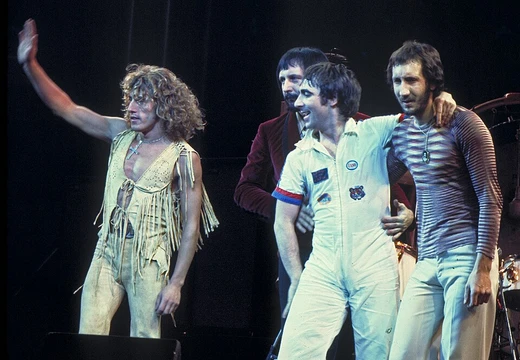
The stage at Wembley is still warm from the previous set. Daltrey stands at the mic, sweat darkening the collar of his shirt, and the crowd is a low, rolling ocean of bodies. He taps the mic once. The silence is absolute. Then Pete's guitar cuts in—that chug-chug-chug riff, raw and immediate, and the sound system shudders. Keith is already driving the kick drum like a piston. John's bass locks the groove into the floorboards. Daltrey opens his mouth and the first line hits the crowd like a physical blow. Forty thousand people inhale together. The chorus comes, and the stadium roof vibrates. Somewhere in the third row, a kid who's never heard the song before is mouthing the words, feeling the rhythm in his sternum, understanding without understanding. That's the thing about "Substitute." You don't need to know the history. You just need to feel the engine turn over and the road open up in front of you.
Reader's Guide
Musical DNA: "Substitute" is built on a relentless, four-beat chugging guitar riff in a mid-tempo rock groove. The key is straightforward, the chord changes are minimal, and the entire architecture is designed to serve momentum. Keith Moon's drumming is the engine—kick-snare-kick with a hi-hat pulse that locks in with the bass, creating a driving, almost motorik feel. John Entwistle's bass line is deceptively simple, anchoring the low end while leaving space for the guitar to cut through. Roger Daltrey's vocal delivery is aggressive, nasal, and slightly desperate, sitting just above the instrumental bed rather than soaring over it. The song runs roughly three and a half minutes, with a short instrumental break in the middle before the final chorus cycle. There is no extended solo. The production is tight, dry, and loud, typical of the Who's live-in-the-studio approach on *Who's Next*. Creation story: Townshend wrote the song during the *Who's Next* sessions, drawing directly from his own experiences with prescription medications and the wider pill culture of the era. He has described the writing process as almost automatic—the riff came first, and the lyrics poured out as a kind of confession that he then universalized. The band tracked it quickly, and the live feel of the take was preserved rather than over-produced. Cultural footprint: "Substitute" became one of The Who's most reliably requested live numbers, a song that could go from the first show of a tour to the last without losing its impact. It has been covered, sampled, and referenced in film, television, and advertising, but it always lands hardest in the context of a full-band, full-volume rock performance. It is the song that reminds people why The Who mattered: not for the rock opera ambition, not for the theatrical staging, but for the sheer, unadorned force of four musicians making a room shake. Why it's inseparable from The Who's identity: In a catalog that ranges from the baroque sprawl of *Tommy* to the pop-clever "I Can't Explain," "Substitute" is the purest distillation of the band's core identity. It is rock and roll as a physical event. It is the riff. It is the shout. It is the crowd jumping. Strip away every other song in the setlist and "Substitute" still tells you exactly who The Who are.
Did You Know?
- The song's title word 'substitute' is repeated throughout the lyrics as a kind of mantra, reinforcing the idea that the narrator is not the real experience but a stand-in for a former lover.
- Pete Townshend has described the riff as something that came to him almost fully formed, and the band recorded the basic track in a single, energetic pass to preserve the live feel.
- "Substitute" has been a regular part of The Who's live setlists for over five decades, making it one of the few songs the band has never dropped from their concerts.
More in Signature Songs & Riffs
Elsewhere in the The Who universe
Spotted an error? Know more?
This is a living reference — every entry is fact-audited, and reader corrections feed straight into our audit queue. Suggest an edit · See this site's audit record