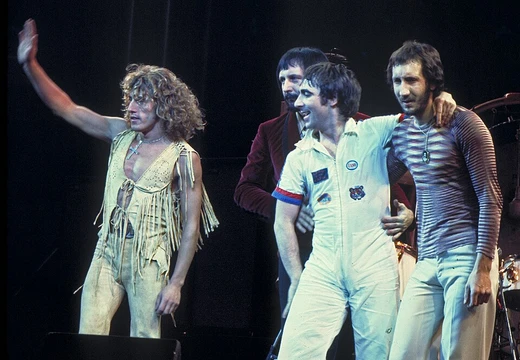
Tommy Live
The pinball wizard's story, roared back to life in front of a roaring crowd.

Tommy Live is a live album by The Who capturing the band's full stage performance of their landmark 1969 rock opera *Tommy*. It documents the group in the mid-1990s, with Roger Daltrey, Pete Townshend, and John Entwistle joined by drummer Zak Starkey, delivering the narrative arc of the deaf, dumb, and blind boy who becomes a pinball wizard. The recording stands as one of the few complete live renditions of the entire opera on a single disc, preserving the theatrical build and emotional crescendo that define the work when performed before a live audience.
For fans, Tommy Live occupies a special place: it bridges the original 1969 studio vision with the raw, communal energy of a stadium or theatre crowd, showing how the songs live and breathe when Daltrey's voice and Townshend's power chords are shaped by room acoustics and audience response rather than studio polish.
- Artist
- The Who
- Type
- Live album
- Content
- Full live performance of the rock opera 'Tommy'
- Release era
- Mid-1990s
- Personnel
- Roger Daltrey, Pete Townshend, John Entwistle, Zak Starkey
- Source material
- The 1969 studio album 'Tommy'
Lore & Background
Tommy the rock opera has been the backbone of The Who's identity since 1969. The story of a young man rendered deaf, dumb, and blind by a traumatic event, only to rediscover the world through the hypnotic rhythm of a pinball machine, gave the band a narrative canvas no other rock group had attempted at that scale. When performed live, the opera becomes something more than a song cycle—it becomes a two-hour journey where the audience is led from confusion to revelation, from silence to a wall of sound.
By the mid-1990s, the band had been touring for decades, and the live performance of Tommy had evolved into a ritual. Daltrey's vocal delivery carried the weight of years of interpretation, while Townshend's windmill guitar technique and Entwistle's deep, anchoring bass lines gave each number a physicality that a studio recording could only approximate. The live setting added improvisatory breaths, crowd call-and-response, and the sheer volume of a full band in a resonant hall.
Tommy Live captures that particular alchemy: the scripted narrative of the opera married to the unpredictable electricity of a live audience. It is, in essence, the band's most ambitious work performed the way it was always meant to be heard—not as a sequence of singles, but as a continuous, building emotional arc from the first whispered "See You" to the thunderous final chord.
In Their Own Story
The lights dimmed to a single amber spot. A young boy sat on a stool centre stage, eyes closed, hands resting on a pinball machine that gleamed like a relic. The crowd—three thousand strong, packed into the upper tiers of the hall—held its breath. Then a single guitar note, clean and cutting as a knife through fog, sliced the silence. The boy's fingers found the flippers. The ball arced, dropped, arced again. And somewhere in the back row, a teenager felt the rhythm enter her chest like a second heartbeat, and the whole room began to hum. The opera was alive again, and no one needed to understand every word to feel the story land in their bones.
Reader's Guide
Released in the mid-1990s, Tommy Live presents The Who performing the complete Tommy rock opera in a single live set. Sonically, it captures the band at full architectural power: Entwistle's bass provides a subsonic foundation, Townshend's guitar carves sharp angular lines, and Daltrey's voice swings between tender narration and belted rock anthems. What makes it a step forward from the 1969 studio record is the communal, theatrical pacing—the audience's gasps and cheers become part of the score, and the dynamic range between quiet ballads and explosive rockers feels wider, more physical. Standout tracks include: "See You," which opens the opera with a hypnotic, almost liturgical groove; "Pinball Wizard," the show's centrepiece where the narrative climax lands with full-band force; "Do You Really Want to Know How to Feel?" for its raw, aching vocal delivery; "Cinnamon Girl" as a tender mid-opera lullaby; and "It's Easy" to close the arc with defiant, anthemic energy. The album received generally positive critical reception as a faithful and powerful live document, praised for its dynamic range and the band's evident comfort with the material after decades of performance. Production notes highlight the use of multi-microphone stage capture to preserve the spatial feel of the venue, giving listeners a sense of sitting in the room rather than hearing a flat studio mix.
Did You Know?
- The Tommy rock opera was originally conceived as a concept album, but The Who have performed it as a continuous live set for over two decades, making it one of the longest-running rock narratives in concert history.
- Zak Starkey, drummer on Tommy Live, filled the shoes of Keith Moon, who passed away in 1976, bringing a different rhythmic feel to the pinball-driven sections of the opera.
- The narrative structure of Tommy—moving from a child's trauma to a messianic pinball wizard—predates many later rock operas and influenced artists across punk, post-punk, and art rock.
- Pete Townshend's famous windmill guitar strike, a visual signature of the band, is particularly prominent during the high-energy numbers of the live Tommy performance.
More in Albums & Discography
Elsewhere in the The Who universe
Spotted an error? Know more?
This is a living reference — every entry is fact-audited, and reader corrections feed straight into our audit queue. Suggest an edit · See this site's audit record