Face Dances
The Who's ninth studio album, released in 1981, featuring Kenney Jones on drums and a cover painted by 16 British artists.

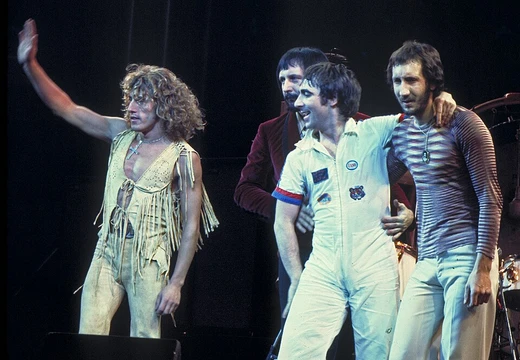
Face Dances is the ninth studio album by the English rock band the Who, released in 1981 by Warner Bros. in the United States and on Polydor in the United Kingdom. It is one of two Who studio albums with drummer Kenney Jones, who joined the band after Keith Moon's death three years earlier. Despite mixed reviews from Rolling Stone and other critics, the album peaked at No. 4 on the US Billboard Top LPs & Tape chart and No. 2 on the UK Albums Chart. The album was originally to be titled The Who, but the name Face Dances replaced it just before release, inspired by a friend of Pete Townshend's who was rhythmically moving a match between her teeth—an action Townshend jokingly termed "face dances."
- Artist
- The Who
- Release year
- 1981
- Band members at recording
- Roger Daltrey, Pete Townshend, John Entwistle, Kenney Jones
Verified Timeline
Lore & Background
The album's title came from a moment Pete Townshend observed: a friend rhythmically moving a match between her teeth, which he jokingly called "face dances." This incident is described in the first verse of Townshend's song "Face Dances, Pt. 2." Townshend later realized he had been inspired by the Face Dancers in Frank Herbert's Dune series, saying: "It was only later that someone pointed out to me that in the Dune trilogy there are a group of characters called 'face dancers,' sort of like chameleons; they can change completely for special purposes. That must have stuck in my head because I really loved the first one." The album cover features 16 paintings of the band members by 16 British painters, commissioned by Peter Blake—designer of the cover of the Beatles' album Sgt. Pepper's Lonely Hearts Club Band. Artists included Tom Phillips, Richard Hamilton, Allen Jones, David Hockney, Clive Barker, R. B. Kitaj, Howard Hodgkin, Patrick Caulfield, David Inshaw, Mike Andrews, Joe Tilson, Patrick Procktor, David Tindle, and Blake himself. Photographer Gavin Cochrane took a reference photo of each of the four band members—Pete Townshend, Roger Daltrey, John Entwistle, and Kenney Jones—which the 16 artists used to paint 6 in × 6 in canvases for the front cover.
In Their Own Story
R. B. Kitaj, a Jewish American from Chagrin Falls, Ohio who made his home in England and was elected to the Royal Academy in 1991—the first American to do so since John Singer Sargent in the 1890s—did a charcoal portrait on Ingres paper of John Entwistle for the cover. David Inshaw, a member of the Brotherhood of Ruralists along with Peter Blake and Jann Howarth and Graham and Annie Ovenden in the 1970s, painted a portrait of Roger Daltrey. In 1973, Inshaw's painting 'The Badminton Game' was exhibited at the ICA Summer Exhibition and was subsequently acquired by the Tate. Richard Hamilton, one of the first British Pop artists known for his painting and collage work, did a portrait of Pete Townshend. Hamilton was the cover designer of the Beatles' self-titled 1968 album and its poster insert, and was also known for his painting 'Swingeing London 67 (f)' which depicted Mick Jagger and art dealer Robert Fraser in handcuffs following their arrest on drug charges. The first single from the album, "You Better You Bet," had a music video that was one of the first music videos aired on MTV in 1981, and was the first to be repeated on the channel. "Don't Let Go the Coat" was the second single, also with its own music video. While a video was shot for "Another Tricky Day," the song was not released as a single commercially but was a US Album Rock Top 10 track.
Reader's Guide
Face Dances celebrated its 40th anniversary with the release on 12 June 2021 on Record Store Day 1 of a 2-LP expanded coloured vinyl version—LP1 is blue and LP2 is yellow. Both discs were mastered by Jon Astley at Close To The Edge and cut at half speed by Miles Showell at Abbey Road Studios. The pressing was limited to 6500 copies. LP1 is the newly re-mastered version of the album, while LP2 has a side of studio out-takes and four live tracks from the band's 1981 Rockpalast show which appear for the first time on vinyl. In 1993, Polydor re-released the album on CD, including only the songs from the original LP. In 1997, the album was remixed, remastered, and rereleased by MCA with three outtakes as well as two live tracks. The live track "How Can You Do It Alone" is an edited version of the live performance. The album's personnel includes Roger Daltrey on lead vocals, Pete Townshend on guitar, keyboards, backing vocals, and lead vocals on "I Like Nightmares," "Somebody Saved Me," and "How Can You Do It Alone (Live, 1979)"; John Entwistle on bass, backing vocals, and lead vocals on "The Quiet One"; Kenney Jones on drums; and John "Rabbit" Bundrick on additional keyboards.
Did You Know?
- The album was originally to be titled The Who, but the name Face Dances replaced it just before release.
- The phrase 'face dances' was inspired by a friend of Pete Townshend's who was rhythmically moving a match between her teeth.
- The album cover features 16 paintings of the band members by 16 British painters, commissioned by Peter Blake, designer of the Beatles' Sgt. Pepper's Lonely Hearts Club Band cover.
- R. B. Kitaj, who painted John Entwistle's portrait for the cover, was the first American elected to the Royal Academy since John Singer Sargent in the 1890s.
- The music video for 'You Better You Bet' was one of the first music videos aired on MTV in 1981, and was the first to be repeated on the channel.
More in Albums & Discography
Elsewhere in the The Who universe
Spotted an error? Know more?
This is a living reference — every entry is fact-audited, and reader corrections feed straight into our audit queue. Suggest an edit · See this site's audit record