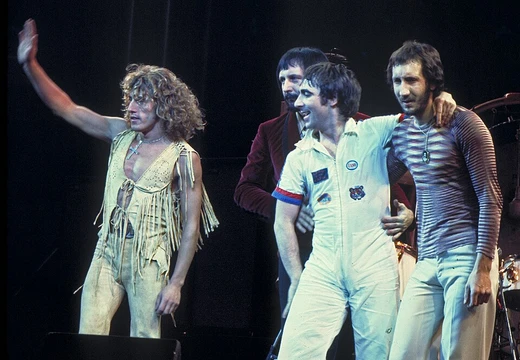
The Who
Four Londoners who turned a guitar, bass, drums, and voice into pure thunderstorm.

The Who are a London-born rock band whose discography charts one of the most dramatic arcs in popular music: from the snarling, two-chord fury of the mid-1960s mod scene to the sprawling, theatrical rock operas of the late 1960s and early 1970s, and onward into the muscular, precision-cut hard rock that defined their mid-period. Their albums are not merely collections of songs but fully realized sonic environments, each one a distinct world built from the interplay of Roger Daltrey's commanding voice, Pete Townshend's slashing guitar work, John Entwistle's thunderous bass, and Keith Moon's explosive drumming. Across their studio recordings, The Who moved with a rare ambition for a band rooted in live performance. They experimented with studio effects, narrative structure, and commercial self-awareness, yet never lost the physical, almost violent energy that made their live shows legendary. Their catalog remains a touchstone for anyone studying how a rock band can be simultaneously raw and cerebral, chaotic and tightly composed.
- Genre
- Rock, Mod, Progressive Rock, Hard Rock
- Formed
- 1964, London, England
- Original lineup
- Roger Daltrey (vocals), Pete Townshend (guitar), John Entwistle (bass), Keith Moon (drums)
- Signature albums
- Tommy, Quadrophenia, Who's Next
- Cultural association
- Mod subculture, British Invasion, live instrument destruction
- Live tradition
- The 'breakdown' set structure, ending with instrument smashing
Lore & Background
The Who emerged from the working-class streets of London's north in the early 1960s, initially as a mod-influenced skiffle and R&B outfit before crystallizing into the four-piece that would become iconic. Their early identity was inseparable from the mod subculture: the sharp suits, the scooters, the specific brands and sounds that defined a generation's youth identity in Britain. The band's live shows were built around a ritual of controlled destruction—guitars and basses smashed to splinters in the final moments, the drum kit battered into unrecognizable wreckage—turning every concert into a kind of cathartic demolition. Pete Townshend became the band's primary songwriter and conceptual architect, channeling his own struggles with fame, identity, and the music industry into increasingly ambitious narratives. The result was a body of work that treated rock music as a vehicle for storytelling on a scale previously reserved for theatre and film. John Entwistle's bass lines provided a low-end architecture that was as melodic and driving as any lead instrument, while Keith Moon's drumming was a force of nature—simultaneously technically precise and gloriously unhinged, a constant source of both musical brilliance and legendary backstage mayhem. The band's internal dynamics, their clashes with managers and the music business, and the personal tragedies that marked their later years all left audible traces in the recordings. The Who's music carries the weight of those experiences: the anger, the humor, the exhaustion, and the stubborn refusal to let the music become merely commercial, even when the industry demanded it.
In Their Own Story
The arena is dark except for a single white light cutting through the haze. The crowd is a single breathing organism, ten thousand chests rising and falling in unison. Then the first chord hits—not a note, a wall of sound that you feel in your molars before your ears register it. The bass drops in like a second heartbeat, and the drums arrive not as rhythm but as weather, a sudden downpour of sticks on cymbals. The singer's voice cuts through the mix like a blade through fog, and for three minutes the only thing that exists is the sound, the vibration, the sheer physical fact of four people making the air itself move. When the last note rings out and the guitarist lifts his instrument overhead, the silence that follows is louder than anything that came before. Then the crack. The splinter. The roar of ten thousand people who just witnessed something that will not happen the same way again.
Reader's Guide
The Who's early studio work—anchored by the 1965 debut—sounds like a car engine revving in a narrow street: tight, urgent, mod-tinged, every note serving the groove. The mid-period experiments, including the self-aware commercial pastiche of their 1967 record, push the band into studio-as-instrument territory, layering jingles, orchestration, and deadpan comedy over the rock core. Then comes the rock opera era. Tommy stretches across a full LP of narrative, its sound a vast, theatrical canvas where a single sustained chord can hold for minutes, building to a wall of feedback and drums that feels architectural. Quadrophenia tightens that ambition into a more focused, rhythm-driven story, its mod-inflected guitar work and pounding bass lines creating a sonic portrait of a specific time and place. Who's Next represents the distillation: the operatic sprawl stripped away, leaving pure, muscular hard rock. The production is dense, the arrangements ruthless, and the songs feel like they were carved rather than composed. It sits at the center of their discography as the point where ambition and economy finally became the same thing. Later albums push into more personal, experimental territory, but the sonic DNA established in those core records—the interplay of voice, bass, and guitar as a unified engine—remains the gravitational center of everything The Who have made since.
Did You Know?
- The Who's live shows traditionally ended with a 'breakdown' in which the guitarist and bassist smashed their instruments, a ritual that became a defining image of the band's identity.
- Pete Townshend's signature 'windmill' guitar strumming technique—swinging the pick in a full circular motion—was developed partly as a way to play fast while managing a painful wrist condition.
- The band's rock opera Tommy was conceived as a theatrical concept and was later adapted into a stage musical and a feature film, making it one of the most frequently adapted rock narratives in history.
- Keith Moon was so prolific and destructive in the studio that his drum kits were frequently replaced mid-session, and he was known for filling his drum hardware with unusual objects to alter the sound.
More in Albums & Discography
Elsewhere in the The Who universe
Spotted an error? Know more?
This is a living reference — every entry is fact-audited, and reader corrections feed straight into our audit queue. Suggest an edit · See this site's audit record