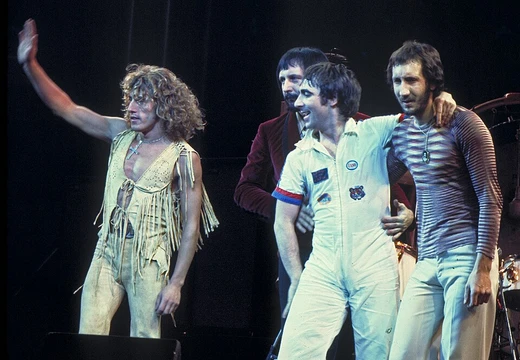
The I'm a Boy Era
A boy, a hook, and a band finding its voice in 1966.

The 'I'm a Boy Era' refers to the narrow window in The Who's story—centered on 1966—when the band's early Mod-era identity was crystallizing around Pete Townshend's sharp, character-driven songwriting. The title track, a punchy, hook-laden single, became a signature of that transitional moment: the band was shedding its raw R&B covers act and forging a distinct pop-rock voice that would soon explode into rock opera. In fan parlance, the era captures The Who at a specific creative inflection point—still young, still building their live mythology, but already writing songs that felt like small theatrical sketches. It sits between the earliest Mod anthems and the grander ambitions of Tommy, a brief but electric chapter where the band's personality was still being written in real time.
- Title track
- I'm a Boy
- Writer
- Pete Townshend
- Year of release
- 1966
- Band
- The Who
- Era context
- Mod period / pre-Tommy
- Live status
- Long-standing concert staple
Lore & Background
In the summer of 1966, The Who were still the lads from Acton and Lee, still in their tight Mod suits and still building the ferocious live reputation that would make them legends. But the songwriting was shifting. Pete Townshend, then only nineteen, was moving past simple love songs and into character pieces—small, sharp vignettes of young people caught in confusion, frustration, or self-discovery. 'I'm a Boy' landed squarely in that lane: a young man asserting his identity over and over, the 'da-da-da-da' hook functioning almost like a mantra, a declaration that he is who he is despite the world's expectations. The song's energy was a perfect match for the band's live approach. Keith Moon's drumming was already developing its chaotic, thunderous personality; John Entwistle's bass lines were locking in with a precision that made the whole rhythm section feel like a single machine. Roger Daltrey's vocal delivery on the track carried that particular Who snarl—half shout, half sneer—that would become the band's trademark. In the Mod clubs of London, the song hit like a small detonation: fast, funny, and just a little confrontational. Culturally, the era was also about identity in a very British, very 1960s sense. The Mod scene was all about style, class, and the performance of self. A song about a boy insisting 'I'm a boy' resonated with a generation of teenagers who were still figuring out who they were, what they wanted, and how to be seen. It was a small song, but it carried the weight of a whole generation's coming-of-age anxiety, and The Who delivered it with the kind of reckless joy that made their audiences feel like they were part of something electric and irreversible.
In Their Own Story
The Marquee, a Tuesday in '66. The air is thick with cigarette smoke and the smell of wet wool from the coats piled by the door. A kid in a parka, maybe sixteen, leans against the bar and watches the band set up. Keith is already tapping his sticks on the toms, grinning like he's about to tell a joke he hasn't finished yet. Pete slaps his guitar strap on, tunes one string, then stops. He looks at the crowd—maybe two hundred people, packed shoulder to shoulder—and something in his face shifts. The next song is going to be 'I'm a Boy.' He mouths the first syllable to himself, feels the 'da-da-da' in his teeth. Roger bounces on the balls of his feet, already hearing it. The lights drop. The first chord cracks through the room like a whip. And for three minutes and forty seconds, the kid in the parka forgets his name, his school, his mum's voice on the phone. He is just a body in a crowd, swaying, mouthing the words, feeling the bass in his sternum. When it ends, the room detonates. Keith laughs. Pete doesn't. He's already thinking about the next song.
Reader's Guide
The I'm a Boy Era is best understood as a single, bright flash in The Who's early arc—the moment when their Mod-era identity peaked just before the band leapt into the rock-opera wilderness of Tommy. Musically, the period was defined by tight, three-to-four-minute pop songs with a live edge: driving bass, explosive drums, and Pete Townshend's rhythm guitar cutting through like a staccato knife. The songs were short, punchy, and often built around a single vocal hook that the audience could grab and shout back. Culturally, The Who were still the Mod band—tight suits, clean lines, a working-class swagger that set them apart from the flower-power drift already gathering on the horizon. The audience was young, urban, and hungry for something that felt like a punch in the ribs rather than a lullaby. Live, the band was already developing the destructive, percussive intensity that would become their signature, but the setlists were still anchored by these Mod-era singles. The key turning point of the era was the band's growing confidence in Townshend's songwriting. He was no longer just writing covers or simple pop; he was building small narratives, small characters, small stories. 'I'm a Boy' is a perfect example: a young man, a declaration, a hook. It's not a rock opera, but it's the seed of one. By the end of 1966, the band was already sketching the outlines of something far bigger, and the Mod-era songs—'I'm a Boy' included—would become the foundation on which that bigger thing was built. The lineup was stable: Daltrey, Townshend, Entwistle, Moon. No shifts, no drama, just four young men in a London club, getting louder and more confident with every night. The era ended not with a bang but with a pivot—the first notes of 'My Generation' on the radio, the first whispers of a concept album, the Mod suits giving way to something looser, wilder, more theatrical. The I'm a Boy Era was brief, but it was the era where The Who became The Who.
Did You Know?
- Pete Townshend wrote 'I'm a Boy' at just nineteen, in the same burst of songwriting that produced several of The Who's early Mod-era staples.
- The song's distinctive 'da-da-da-da' vocal hook became one of the most instantly recognizable riffs in The Who's live set, often used as a crowd-participation moment.
- The I'm a Boy Era coincided with The Who's peak Mod identity—tight suits, clean lines, and a working-class London swagger that set them apart from the emerging psychedelic scene.
- Keith Moon's drumming on the track already shows the chaotic, thunderous personality that would become his trademark, even though he was still in his early twenties.
More in Eras & Timeline
Elsewhere in the The Who universe
Spotted an error? Know more?
This is a living reference — every entry is fact-audited, and reader corrections feed straight into our audit queue. Suggest an edit · See this site's audit record