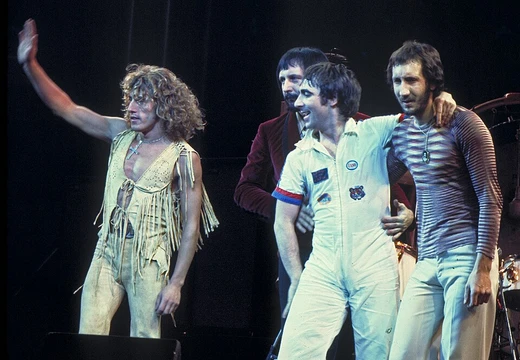
The Who: Live at the Fillmore East
Four men, one stage, and a New York crowd that never saw the same show twice.

The Who: Live at the Fillmore East captures the band at the height of their live reputation, recorded in 1969 at one of New York City's most legendary rock venues. The Fillmore East, with its intimate yet electric atmosphere, had become a proving ground for the era's biggest acts, and The Who's appearance there cemented their status as the definitive live rock experience of the late sixties. This recording sits at a pivotal moment in the band's evolution—past the mod-era singles, deep into the extended, theatrical live sets that would eventually birth Tommy. It represents The Who not as a studio ensemble but as a four-piece force of nature, trading riffs and building walls of sound in real time before a packed New York crowd.
- Artist
- The Who
- Venue
- Fillmore East, New York City
- Year
- 1969
- Genre
- Rock / Psychedelic Rock
- Format
- Live concert recording
- Band members on stage
- Roger Daltrey, Pete Townshend, John Entwistle, Keith Moon
Lore & Background
By 1969, The Who had become synonymous with a particular kind of live spectacle: songs that grew, shifted, and collided with each other in ways no studio record could replicate. The Fillmore East shows were no exception. Townshend's windmill guitar work, Moon's percussive chaos, Entwistle's bass lines that doubled as a second guitar, and Daltrey's bellowing vocals created a performance that felt almost dangerous in its physicality. Audience members recalled the sheer volume and the way the band would feed off the room's energy, stretching transitions into improvised passages that never repeated. The Fillmore East itself was a character in the story. Tucked into the East Village, it was smaller and more claustrophobic than the West Coast Fillmore, which meant the sound hit the audience like a physical force. The band's setlists from this era typically wove together their mod-era catalog with the newer, longer compositions they were developing in the studio. The result was a journey from punchy three-minute songs to sprawling, almost operatic passages that blurred the line between rock and theater. For fans, recordings from this period carry a particular weight: they document the band not as a polished product but as a living, breathing, occasionally chaotic organism. You can hear the band arguing, laughing, and reacting to each other in real time. It is The Who as they actually were on a Tuesday night in New York, not as a producer later shaped them for a record sleeve.
In Their Own Story
The house lights dimmed and the smell of cheap beer and hot tube amps filled the room. Keith Moon was already three songs into a drum solo that hadn't technically started yet, his sticks flying in patterns that seemed designed to disassemble the kit. Pete stood at the edge of the stage, guitar held low, watching the crowd sway like wheat in a wind. Roger grabbed the mic stand and simply roared a single sustained note that made the back row wince. John, in his leather jacket, leaned into his bass amp and let it feedback until the whole room hummed. Then, without a word exchanged, they launched into the next song as if they'd been rehearsing it for years. The Fillmore East shook. Someone in the third row dropped their drink. Nobody cared.
Reader's Guide
This recording functions as a time capsule of The Who's live identity in 1969, a period when the band was in full transition between their mod-era catalog and the ambitious studio work that would follow. The thematic arc of a typical set moves from recognizable, punchy rockers into longer, more exploratory passages, creating a narrative of escalation that mirrors the band's own creative journey. Sonically, the mix captures the raw, unpolished energy of a live venue. The guitars are thick and slightly compressed, the drums ring out with the natural reverb of a wooden room, and the bass sits in a pocket that feels almost orchestral in its weight. There is no overdubbing, no safety net—what you hear is four musicians in a room, making decisions in real time. Townshend's guitar tone is aggressive and bright, cutting through the mix with a percussive attack that defines the band's signature sound. In the broader context of The Who's musical universe, this recording occupies the space between the tight, mod-influenced early work and the sprawling, conceptual ambitions of their later albums. It is the bridge: the band still playing songs the audience knows and loves, but pushing those songs into new territories of length, dynamics, and improvisation. It sounds like a band that has outgrown the three-minute format but hasn't yet found the vocabulary for what comes next.
Did You Know?
- The Fillmore East was significantly smaller and more intimate than its West Coast counterpart, which meant The Who's wall-of-sound approach hit the audience with particular physical force.
- The band's live sets in this era were notorious for their unpredictability—songs would stretch, merge, or be abandoned mid-performance depending on the room's energy.
- Keith Moon's drumming during this period was so physically destructive that venue owners began posting warnings about the condition of their stages after The Who played.
- The Who's live reputation in 1969 was so formidable that they were sometimes booked specifically to fill venues where other acts had struggled to generate energy.
More in Albums & Discography
Elsewhere in the The Who universe
Spotted an error? Know more?
This is a living reference — every entry is fact-audited, and reader corrections feed straight into our audit queue. Suggest an edit · See this site's audit record