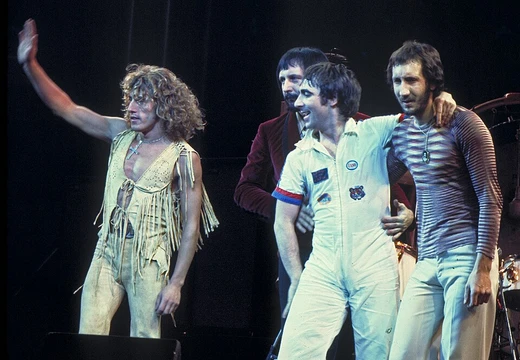
Who
Four lads from Acton who turned a stadium into a demolition site and called it a song.

The Who are a British rock band formed in London in 1964, built around the explosive chemistry of vocalist Roger Daltrey, guitarist and primary songwriter Pete Townshend, bassist John Entwistle, and drummer Keith Moon. Often called the 'mod' band of the 1960s, they became one of the defining acts of rock music through their ferocious live shows, their signature power-chord riffs, and their willingness to treat the concert as a kind of controlled demolition. Their discography spans from the raw, mod-inflected singles of the mid-sixties to the sprawling rock operas Tommy and Quadrophenia, and onward through the lean, muscular hard rock of Who's Next and the later solo-collaboration era with Townshend and Daltrey carrying the torch after the deaths of their bandmates.
- Genre
- Rock, Mod, Progressive Rock, Hard Rock
- Origin
- London, England
- Formed
- 1964
- Founding members
- Roger Daltrey, Pete Townshend, John Entwistle, Keith Moon
- Signature sound
- Power chords, feedback, driving backbeat, theatrical stage destruction
- Status
- Daltrey and Townshend remain active; Moon (d. 1978) and Entwistle (d. 2002) deceased
Lore & Background
The Who emerged from the London mod scene of the early 1960s, where fashion, speed, and a particular brand of working-class swagger defined a generation. Townshend's downstroke power chord—struck with the back of the pick, aimed at the audience—became the band's sonic fingerprint, a sound that was less about melody and more about the physical sensation of a wall of electricity. Their early live sets were legendary for their chaos: Moon would kick his drum kit over, douse it in petrol, and set it alight; Townshend would hurl his guitar into the crowd. This wasn't mere showmanship. It was a philosophy. The music was meant to be felt in the chest before it was heard in the ear, and the destruction on stage was the visual thesis of that argument.
The band's creative peak in the late sixties and early seventies produced two of rock's most ambitious narrative works. Tommy, recorded in 1969, told the story of a deaf, dumb, and blind boy who finds transcendence through rock-and-roll, and it introduced the band to a global audience that had previously known them only as a live act. Quadrophenia, arriving in 1973, followed a single day in the life of a mod teenager in 1964 London, weaving together Entwistle's bass lines, Moon's thunderous fills, and Daltrey's soaring vocal delivery into a story about identity, conformity, and the desperate search for a self that the world keeps trying to overwrite. Between those two operas sat Who's Next (1971), which stripped away the narrative pretension and delivered some of the tightest, most emotionally direct rock the band ever wrote—songs about bargaining with fate, cobalt skies, and the quiet grief of watching someone you love walk away.
After Moon's death in 1978 and Entwistle's in 2002, the surviving members continued to perform and record, but the band's identity became inseparable from the memory of the four. Townshend's songwriting grew more introspective and autobiographical, while Daltrey's voice, weathered by decades of screaming into amplifiers, took on a gravelly, aching quality that made even the simplest ballads feel like they were being torn from the singer's throat. The Who remain a band that lives as much in the audience's memory as in the recordings, a group whose greatest album might be the one you attended at a festival in 1972 and never quite recovered from.
In Their Own Story
The arena in Manchester was already shaking before the first note hit. Daltrey stood at the mic, his white suit catching the stage lights, and the crowd roared a sound that felt less like applause and more like a collective exhalation after holding their breath for twenty minutes. Townshend raised his guitar, the downstroke cutting through the air with a crack that made the front row flinch. The first chord landed like a fist through a window. Moon, behind his kit, grinned at nothing in particular and let the ride cymbal scream. Entwistle's bass punched up from the floor, a physical thing you felt in your molars. For four minutes and thirty seconds, the building was not a building. It was a living thing, breathing in time with the rhythm, and when the feedback swelled and the amps howled, the audience didn't cheer. They exhaled. And then Daltrey leaned into the mic and sang the words that made a man in the third row press his fist to his chest and remember every summer he'd ever lost.
Reader's Guide
The Who's recorded output runs from 1965 through the 2010s, released primarily on Track Records, Decca, Polydor, MCA, and Geffen across the decades. Their sonic identity is built on Townshend's power-chord guitar, Entwistle's melodic bass lines that often carry the harmonic weight of the song, Moon's relentless backbeat, and Daltrey's vocal delivery that ranges from a snarling bark to a fragile, almost spoken whisper. What made them a step forward in rock was the marriage of that raw, physical sound with increasingly ambitious song structures—multi-minute suites, narrative arcs, and a willingness to let a song breathe for six or seven minutes without losing the audience's grip.
Standout tracks across the catalogue: 'My Generation' (1965) established the band's confrontational, working-class voice and the downstroke as a weapon. 'I Can't Explain' (1965) showed their melodic range and mod sensibility. 'A Quick One' (1966) demonstrated their ability to build a song around a single, escalating groove. 'I Can See for Miles' (1967) is the definitive Who ballad, a song about watching someone you love walk out of your life rendered in sustained, aching vocal lines. 'Pinball Wizard' (1969) from Tommy is the exuberant, comic centerpiece of the rock opera. 'See My Way' (1969) is the emotional climax of Tommy, a duet about finding clarity through loss. 'Bargain' (1971) from Who's Next is a raw, desperate plea that strips the band down to almost nothing. 'Substitute' (1971) is the quintessential Who rocker, a song about the futility of trying to fill a void with another person. 'Won't Get Fooled Again' (1973) from Quadrophenia is the band's grandest statement, a seven-minute epic that builds from a whispered, almost spoken opening to a wall of sound that feels like the end of the world. 'Love, Reign O'er Me' (1973) is the quiet, devastating coda to Quadrophenia, a song about the impossibility of going back.
Chart performance varied by market: the band was a live phenomenon in the UK and a recording act in the US, where Tommy and Quadrophenia became their breakthrough studio releases. Critical reception has been consistently strong, with Who's Next, Tommy, and Quadrophenia routinely cited among the greatest rock albums ever made. A notable production quirk is that much of the early work was recorded quickly and live in the studio to capture the band's energy, while the rock operas involved months of overdubbing and orchestral arrangement. Townshend's production style favored a dry, close-miked sound that let every individual instrument cut through, a choice that gave the recordings a physical, almost aggressive immediacy that set them apart from the more polished productions of their contemporaries.
Did You Know?
- Pete Townshend's signature downstroke power chord was partly a practical solution: by striking the strings with the back of the pick and aiming the guitar at the audience, he could project sound without relying on the am
- Keith Moon was so prolific a drummer that the band's manager reportedly had to lock the drum kit in a room between gigs to prevent Moon from destroying it, a precaution that became a running joke within the group.
- The Who's early mod aesthetic—white suits, clean lines, a particular way of holding a cigarette—was not just fashion but a statement of class identity, a deliberate rejection of the working-class roughness that defined m
- John Entwistle's bass lines on Quadrophenia are so melodic and prominent that in several tracks he is effectively the lead instrument, a role that was unusual for a bassist in 1973 and that influenced a generation of pla
More in Albums & Discography
Elsewhere in the The Who universe
Spotted an error? Know more?
This is a living reference — every entry is fact-audited, and reader corrections feed straight into our audit queue. Suggest an edit · See this site's audit record