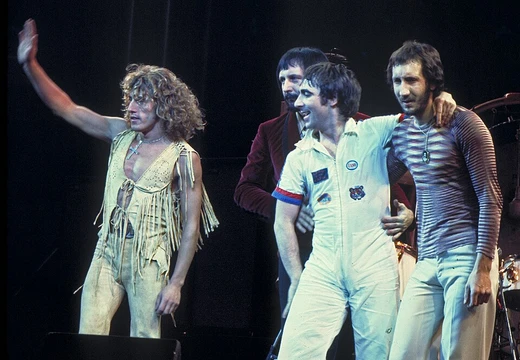
Quadrophenia
A boy, a scooter, a sea, and the four faces that break him open.

Quadrophenia is The Who's landmark rock opera, a sprawling concept album that transformed a single character's psychological unraveling into one of the most enduring narratives in rock music. Written and produced by Pete Townshend and released in 1973, it follows Jimmy Caulfield, a young mod in 1964 London, as he spirals through identity crises, tribal loyalty, and a final, shattering breakdown. The title itself is a deliberate twist on the clinical term 'quadriphenia'—a fourfold personality disorder—signaling that Jimmy's story is less about a single event and more about the fractured self behind the scooter, the suit, and the sea.
In the broader lore of The Who, Quadrophenia represents the band's fullest artistic statement: a theatrical, emotionally raw exploration of youth culture, belonging, and the violence of growing up. It gave fans a protagonist to argue about, a soundtrack to live through, and a story that has been reinterpreted in stages, classrooms, and late-night conversations for over five decades.
- Type
- Rock opera / concept album
- Band
- The Who
- Written by
- Pete Townshend
- Released
- 1973
- Protagonist
- Jimmy Caulfield
- Setting
- 1964 London and Brighton
- Genre
- Rock opera, mod culture, psychological drama
Lore & Background
The world of Quadrophenia is London in the mid-1960s, filtered through the lens of a teenager for whom the mod subculture is not a fashion but a survival strategy. Jimmy Caulfield moves through a city of sharp suits, Vespa scooters, and the electric hum of the 5:15 train to Brighton, where the weekend becomes a ritual of belonging. The mods and the rockers are not merely rival tribes in this world; they are the two poles of a social tension that Jimmy feels in his chest like a pressure valve about to blow. Every gelatinous wig, every tailored jacket, every stolen glance at a girl on the beach is a small act of self-assertion in a world that keeps telling him he is not enough.
The emotional architecture of the story is built on repetition and escalation. Jimmy's identity fractures are not presented as a single dramatic event but as a slow accumulation of small humiliations, rejected connections, and the relentless pull of the sea. The psychiatrist's office, the bellboy's indifference, the crowd at the beach—each encounter chips away at the surface until what remains is a raw, howling question about who he is when the music stops. Townshend crafted this not as a plot in the traditional sense but as a psychological spiral, where the same themes of isolation, performative confidence, and desperate need for a tribe echo and intensify until they shatter.
What makes Quadrophenia endure in fan culture is its refusal to offer a tidy resolution. Jimmy does not triumph. He does not find his place. He simply breaks, and the audience is left in the wreckage, feeling the same cold water close over their ears. That unresolved ache is precisely what makes the story a living thing, one that each generation of listeners reinterprets through their own struggles with identity, belonging, and the fear that the performance they've built is all that stands between them and the void.
In Their Own Story
The platform at London Bridge is packed, the air thick with the smell of wet wool and engine grease. Jimmy stands at the edge, his suit sharp, his hair lacquered into a perfect wave, and he feels the whole crowd's eyes on him like a single burning spotlight. The 5:15 is late. It's always late. Around him, the mods murmur their small rituals—adjusting a cuff, checking a watch that isn't there, laughing at nothing. A rocker's shadow falls across the platform, and for a heartbeat the whole tribe tenses, shoulders squared, the unspoken war humming under the chatter. Then the train groars in, doors split open, and Jimmy is swallowed into the press of bodies, the lurch of acceleration, the green-grey blur of the countryside beyond the glass. He presses his forehead to the cold window. He is nobody here. He is everyone. The sea is waiting, and it does not care about his suit.
Reader's Guide
Legend: The 5:15 Train. In 1973, when the album first hit shelves and then stages, the image of that train hurtling toward Brighton became the single most recognized symbol in The Who's live mythology. Fans who attended the touring shows remember the lights cutting to black, the sound of a locomotive building in the speakers, and the collective gasp as the audience realized they were no longer watching a band but riding a machine that would carry them somewhere they couldn't name. It became shorthand for the entire Quadrophenia experience: the rush, the anonymity, the point of no return.
Fact: The title's clinical roots. Townshend has spoken in interviews about borrowing the word from a psychiatric context, twisting 'quadriphenia' into something that sounds like a musical key. Fans who dug into the liner notes and the early press interviews picked up on this and built a whole interpretive tradition around it—four personalities, four faces, four ways Jimmy tries to be a person and fails. It gave the story a structural logic that fans still argue about in forums and at live shows fifty years later.
Legend: The sea as judge. In every live performance, the moment the music drops to that low, surging swell of water sounds, the audience goes quiet. It is the one moment in the entire show where no one claps, no one sings. The sea in Quadrophenia is not a setting; it is a verdict. Fans who have felt that silence in a stadium of thousands describe it as the closest thing to a shared heartbeat they've ever experienced. It is the story's final word, and it does not forgive.
Did You Know?
- The title 'Quadrophenia' is a deliberate play on the psychiatric term 'quadriphenia,' suggesting a fourfold personality disorder, and Townshend chose the musical-sounding spelling to make it feel like a key signature rat
- The album's narrative is set in 1964 London, a period Townshend personally inhabited as a young mod, making the story a blend of lived memory and theatrical invention.
- A 1979 film adaptation directed by Ken Russell brought the story to the screen, adding a visual dimension to the character of Jimmy Caulfield that expanded the mythos beyond the audio experience.
- The song structure of the album is designed to be experienced as a continuous arc rather than a collection of singles, with transitions and recurring motifs that reward repeated, attentive listening.
More in Lore & Legacy
Elsewhere in the The Who universe
Spotted an error? Know more?
This is a living reference — every entry is fact-audited, and reader corrections feed straight into our audit queue. Suggest an edit · See this site's audit record