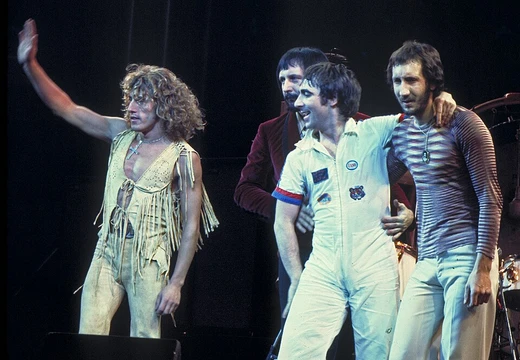
Pete Townshend windmill guitar smash
One circle, one crack, and a generation of rock shows was defined forever.

The windmill guitar smash is the single most recognizable physical gesture in the history of rock and roll: Pete Townshend, lead guitarist of The Who, swinging his instrument in a full overhead circle before bringing it down with a thunderous crack against the stage floor. What began as an exuberant flourish in the late 1960s evolved into the definitive curtain-call of a Who live set, a ritual of controlled destruction that told the audience the show was over and the night's energy had been fully spent.
More than a stunt, the windmill smash became a visual shorthand for the band's philosophy—raw power channeled through a single, decisive act of release. It turned the guitar from a tool of music into a prop of theatre, and it made Pete Townshend's silhouette against a floodlit stage one of the most reproduced images in popular culture. Fans who caught a Who show in that era still speak of the moment the guitar left his grip as the emotional apex of the entire evening.
- Artist
- Pete Townshend
- Band
- The Who
- Role
- Lead guitarist, primary songwriter
- Genre
- Rock / Art rock
- Era of prominence
- Late 1960s onward
- Signature context
- Closing gesture of live performances
- Cultural status
- Iconic symbol of rock-and-roll destruction
Lore & Background
In the mid-to-late 1960s, The Who were building a reputation as the most ferocious live act on the British circuit. Their sets were structured like a narrative arc—building through a sequence of songs that escalated in intensity before culminating in a final, explosive track. Pete Townshend, a left-handed player with a distinctive upstrokes-driven technique, began incorporating increasingly theatrical physicality into his playing. The windmill smash crystallized out of this: a full-body rotation of the guitar overhead, arms extended, the instrument tracing a wide arc before the heel of the body or the neck struck the stage with a resonant, splitting impact.
The gesture was never random. It was choreographed into the set as the definitive punctuation mark. Audiences learned to read it the way a theatre-goer reads a final bow: the music stopped, the lights flared, and the guitar broke. In an era when most rock acts simply stopped playing and walked off, The Who turned the ending into a spectacle of physical commitment. The sound of the smash—amplified by the venue's acoustics, echoing off concrete floors—became almost as important as the music itself.
Over the following decades, the windmill evolved from a nightly necessity into a cultural artifact. It was parodied, imitated, and referenced across film, television, and advertising. Yet for those who experienced it live, the gesture retained its visceral power: the sense that a human being had poured every ounce of creative energy into the performance and then, in one clean motion, let it go. It was destruction as catharsis, and it made The Who's live shows events you did not merely hear but physically feel in your chest.
In Their Own Story
The hall smelled of sweat and hot tube amps. Pete stood at the mic, the final chord still ringing, his breath coming in short bursts. The crowd was a single breathing thing, ten thousand people pressed against the barrier, hands raised. He looked at the guitar in his hands—worn, dented, faithful—and something in his shoulders unclenched. He raised it. The arms went up, the guitar tracing its wide, slow circle above the floodlights, the wood catching the white glare. One full rotation. Two. The audience went silent. Then the downswing, fast and clean, the body striking the stage with a sound like a tree falling in a forest. The neck splintered. A shower of wood chips caught the light and drifted down. Pete stood very still for a moment, then grinned, and the hall detonated.
Reader's Guide
Legend: The First Windmill. Fans who were in the audience at late-'60s Who shows—small clubs, mid-size halls—recall that the smash was not always the same. Early on, Pete would simply hurl the guitar or stomp on it. The full circular windmill, arms fully extended, the instrument tracing a complete arc before impact, solidified around 1967-1968 as the band's live sets grew longer and more structured. It became the non-negotiable final beat of the show. Why it stuck: it was the one moment where the music, the theatre, and the audience's collective breath all aligned into a single physical event. You could not half-experience it.
Fact: The Windmill as Set Architecture. The Who's live sets in this era were famously structured as a continuous musical narrative, often described by fans as a 'rock opera in concert form.' The windmill was the period at the end of that sentence. It told you the story was over. No encore, no small talk. The guitar broke, the band walked, the lights came up. This finality made the show feel complete in a way few other acts achieved.
Legend: The Sound. Older fans will tell you the smash had a specific tone depending on the venue—a dry crack in a small club, a deep, resonant boom in a concrete-floored hall. Some claim you could tell the city just by the sound of the wood hitting the floor. Whether or not that's true, the sound was part of the ritual, the auditory seal on the performance.
Fact: The Cultural Imprint. Within a few years, the windmill had escaped the concert hall. It appeared in films, on album sleeves, in advertising. It became a shorthand for 'rock and roll' itself. For The Who, it was simply the way the show ended. For everyone else, it became the image they remembered.
Did You Know?
- Pete Townshend is left-handed, and the windmill motion is performed with his natural arm extension, making the circular swing feel almost effortless despite the full-body commitment it requires.
- The Who's live sets of the late 1960s were structured as a continuous musical sequence with no gaps between songs, making the windmill smash the only true 'ending' in an otherwise unbroken performance.
- The gesture became so synonymous with The Who that it has been referenced, imitated, and parodied across decades of popular culture, from comedy sketches to film soundtracks.
- Fans who attended multiple Who shows in the same era often report that the emotional impact of the smash never diminished, even after seeing it dozens of times, because the full-body commitment made each one feel genuine
More in Lore & Legacy
Elsewhere in the The Who universe
Spotted an error? Know more?
This is a living reference — every entry is fact-audited, and reader corrections feed straight into our audit queue. Suggest an edit · See this site's audit record