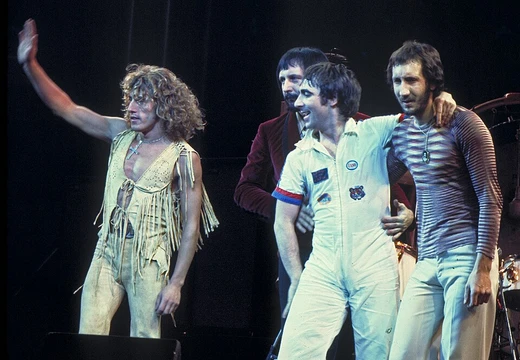
Keith Moon drum kit destruction
He didn't finish the song. He finished the drums.

Keith Moon's drum kit destruction is the most iconic ritual in The Who's live mythology: the practice, perfected by the band's drummer Roger Keith Trevor Moon, of systematically annihilating his own drum set at the climax of a performance. Using a sledgehammer, open flame, and sheer physical force, Moon turned the final seconds of a show into a controlled demolition that left the stage littered with shattered wood, melted chrome, and smoke. It was not merely a gimmick; it was the exclamation point on an entire evening of sonic assault, the physical proof that the band had given everything and then some.
The practice cemented The Who's reputation as the definitive 'raving' rock act of the 1960s and beyond. Audiences came not just to hear the music but to witness the destruction, and the ritual became inseparable from the band's identity. Even after Moon's untimely death in 1978, the tradition of on-stage instrument destruction persisted in The Who's live shows, carried forward by subsequent drummers as a tribute to the man who made it art.
- Subject
- Keith Moon (Roger Keith Trevor Moon)
- Role
- Drummer, The Who
- Affiliation
- The Who (London, England)
- Practice
- Destruction of drum kit at the close of live performances
- Primary tools
- Sledgehammer, open flame, physical force
- Era of prominence
- Mid-1960s through 1978
- Status
- Deceased (1978); tradition continued by successors
Lore & Background
In the mid-1960s, when The Who were still scrabbling for identity among London's mod clubs, Keith Moon discovered that the audience's energy peaked not when the last note faded but when the last drum split open. What began as a half-accidental smash of a snare head with a drum key evolved, over months of touring, into a full theatrical sequence: the sledgehammer came out, the cymbals were cleaved, the kick drum was kicked apart, and then—most memorably—the whole wreckage was set alight. The smell of burning lacquer and melted bearing steel became, for many fans, as much a part of the Who experience as any melody.
Moon's destruction was never mindless. He had a rhythm to it, a choreography that matched the band's tempo, and he treated the kit as an extension of his own body. The destruction was cathartic, almost religious: the music had been built, sustained, and now it had to be unmade. It mirrored the structure of their setlists, which often moved from tight, mod-influenced numbers into sprawling, chaotic epics. The drums were the last thing standing, and the last thing to fall.
The practice also fed directly into The Who's broader stage mythology, alongside Roger Daltrey's microphone-throwing and the band's signature 'raving' aesthetic. It made The Who impossible to replicate in a studio and impossible to tame in a television studio, which is precisely why they became the band they were: defined by what happened in the room, in the moment, with the lights on and the audience close enough to feel the heat of the burning hardware.
In Their Own Story
The last chord of the encore still rang in the rafters when Keith reached past the hi-hat stand and grabbed the sledgehammer he'd been leaning against the monitor. The crowd roared—not a polite applause, a full-throated howl that shook the cheap plaster of the club ceiling. He swung. The bass drum split with a sound like a gunshot in a cathedral. He swung again, and the toms exploded into splinters that rained down on the front row. Then he knelt, pulled the lighter from his waistband, and pressed the flame to the oil-soaked drum heads. Blue smoke curled upward, catching the stage lights in slow golden ribbons. He stood, wiped soot from his forehead, and gave the crowd a single, exhausted thumbs-up. The drums were gone. The set was over. The night belonged to everyone in the room.
Reader's Guide
Legend says the first time Keith really went for it, it was almost an accident—a sledgehammer meant for a stage prop ended up connected to the snare, and the look on the band's faces told him he'd found something. From that point on, the destruction became the period at the end of the sentence. Fans in the mid-'60s would queue for hours not just to hear the set but to be close enough to feel the heat when the kit caught fire. The smell of burning lacquer became a shared sensory memory, a badge of having been *there*.
Fact: Moon's destruction was choreographed, not random. He hit the drums in a sequence that mirrored the band's tempo, treating the finale like a last, violent measure of music. The sledgehammer came out in time with the kick pattern, and the fire was the final rest.
Legend holds that the tradition survived Keith. When the band continued touring after 1978, the drum destruction remained, performed by whoever sat behind the kit, as a small monument to the man who made annihilation an art form. For fans who saw the shows in the '60s and '70s, the sight of sparks and splinters in the last thirty seconds was the moment the whole evening made sense.
Fact: The destruction was also practical in a strange way. It meant the band never had to explain why the drums looked like they'd been through a war. They hadn't been through a war. They'd been through Keith.
Did You Know?
- Keith Moon's drum destruction was not a one-off stunt but a repeated, ritualized element of The Who's live shows spanning roughly a decade, making it one of the most consistent theatrical traditions in rock history.
- The destruction fed into The Who's broader stage identity alongside Roger Daltrey's famous microphone-throwing, creating a unified visual language of controlled chaos that defined the band's live persona.
- After Keith Moon's death in 1978, the tradition of on-stage instrument destruction continued in The Who's touring shows, performed as a tribute to Moon's legacy rather than abandoned.
- Moon's drum kit destruction became so closely associated with The Who that it influenced the broader rock genre, with numerous acts in the late 1960s and 1970s adopting some form of on-stage destruction as a nod to the b
More in Lore & Legacy
Elsewhere in the The Who universe
Spotted an error? Know more?
This is a living reference — every entry is fact-audited, and reader corrections feed straight into our audit queue. Suggest an edit · See this site's audit record