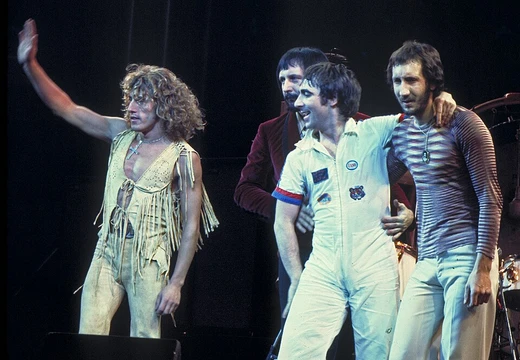
The 2000s Legacy Tours
Two men, a wall of sound, and forty years of thunder still rolling through every arena.

The 2000s Legacy Tours represent the era in which The Who, now a two-piece core of Pete Townshend and Roger Daltrey, carried the band's four-decade catalog across the globe without a new studio album in the mix. Following the devastating loss of bassist John Entwistle in late 2002, the remaining founders proved that the live spectacle—the windmill solo, the high kicks, the wall of feedback—could sustain itself on pure momentum and audience devotion alone.
This decade positioned The Who not as a band still writing their story but as a living monument to 1960s and 70s rock. They became the benchmark against which all classic-rock encore sets were measured, drawing arenas full of fans who had been teenagers in 1973 and were now bringing their own children. The 2000s tours were less a chapter than a sustained encore, a reminder that the music outlived its original configuration.
- Core members
- Pete Townshend, Roger Daltrey
- Period
- 2000–2009
- Major loss
- John Entwistle (died 2002)
- New studio albums in decade
- None
- Cultural role
- Definitive classic-rock live act; legacy headliners
- Touring drummer (mid-2000s)
- Zak Starkey
Lore & Background
By the turn of the millennium, The Who had become something rarer than a band: a shared cultural memory. Pete Townshend, in his late fifties, still launched into the windmill guitar figure with a ferocity that belied the years, while Roger Daltrey's voice—though no longer the raw teenage snarl of 1965—carried a weathered, gravelled authority that made every note of 'Won't Get Fooled Again' land like a verdict. The absence of John Entwistle's bass lines was felt in every set, yet the touring musicians who filled that slot managed to keep the rhythmic engine roaring, and the audience, many of them in their forties and fifties, forgave nothing and demanded everything.
The 2000s tours carried a particular emotional weight. These were not discovery shows for a new generation in the way 1970s stadium tours had been; they were pilgrimage. Fans arrived having heard the records a hundred times, and the live show became a ritual of collective catharsis—the synchronized head-bangs, the shouted lyrics, the moment when the feedback swelled and the lights dimmed and everyone in the pit closed their eyes. Townshend and Daltrey understood this sacred contract. They played 'My Generation' with the same contemptuous energy as 1965, they hit the high kick on 'Baba O'Riley' with theatrical precision, and they closed with the extended, almost religious build of their signature finale.
Behind the scenes, the decade was marked by personal turbulence and creative restlessness. Townshend's struggles with performance anxiety, his ongoing songwriting projects, and the general exhaustion of a man who had been on stage since he was nineteen all shaped the shows. Yet the music never wavered. The 2000s proved that a band's legacy is not a museum exhibit; it is a living, breathing, feedback-drenched organism that only truly dies when the last amp is unplugged and the last audience member walks out into the night.
In Their Own Story
The arena in Manchester was already humming before the house lights dropped. A sea of people—fathers with daughters on their shoulders, couples whose wedding rings had long since worn thin—pressed toward the barrier. The PA system groaned with a low, sustained chord, and then the first guitar note cracked through like a whip. Pete's silhouette appeared at the monitor wedge, white hair catching the spotlights, and the windmill began. Around him, the drummer's sticks blurred into a silver halo. In the third row, a man in his fifties lifted his beer and simply wept, not from sadness but from the sheer, irrational relief of hearing those four chords again, of feeling the bass thump in his sternum as if his own heart had been replaced by a 4x10 cabinet. Roger came out of the shadows, kicked his leg up into the strobe light, and screamed the opening line of a song that was, for this crowd, less a performance and more a resurrection. The roof of the arena vibrated. Somewhere in the upper deck, a teenager who'd never heard the 1973 record was learning the words by osmosis. The legacy passed, one encore at a time, from one generation's chest to the next.
Reader's Guide
2000–2009: The Legacy Decade. The Who entered the 2000s as a two-man institution—Pete Townshend on guitar and vocals, Roger Daltrey on lead vocals—backed by rotating touring musicians after John Entwistle's death in September 2002. No new studio album appeared during the decade; the entire creative energy was channeled into the live show, which remained essentially the same epic setlist the band had refined over thirty years.
The sound was unchanged in philosophy: Townshend's jangly, angular guitar work driving Daltrey's operatic howls, underpinned by a tight rhythm section. Zak Starkey, Ringo Starr's son, handled drums for a stretch of mid-decade touring, bringing a solid, rock-solid pulse that let the two frontmen do what they did best. The cultural position was unassailable: The Who were the standard-bearers of classic rock, the act that younger bands still measured their ambition against.
Two moments bookend the period. The first is Entwistle's passing in 2002, which transformed the band from a quartet into a legacy act and forced a reckoning with mortality. The second is the 2006 world tour, a massive global run that confirmed the band could still fill arenas on four continents, drawing audiences who had been teenagers during the original stadium era and were now middle-aged, bringing their own kids to witness the windmill solo for the first time. Between those two poles, the 2000s were a sustained, thunderous encore that proved the music was bigger than any single lineup.
Did You Know?
- The Who did not release a new studio album at any point during the 2000s; their last LP before the 2010s was 1999's 'The Squeeze,' making the entire decade a pure touring and legacy period.
- Zak Starkey, son of Beatles drummer Ringo Starr, served as The Who's touring drummer during parts of the 2000s, a fact that delighted fans of both bands and drew considerable press attention.
- Roger Daltrey's signature high kick on 'Baba O'Riley' had become such a recognized visual trademark that it was frequently referenced in pop-culture parodies and tribute acts well into the 2000s, even as the original per
- Pete Townshend's windmill guitar solo, a figure he had been performing since the mid-1960s, was still a central, crowd-igniting moment in every 2000s set, proving that a single physical gesture could remain electrifying
More in Eras & Timeline
Elsewhere in the The Who universe
Spotted an error? Know more?
This is a living reference — every entry is fact-audited, and reader corrections feed straight into our audit queue. Suggest an edit · See this site's audit record