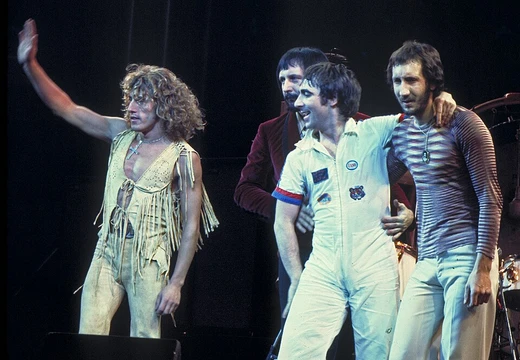
Live at the Isle of Wight Festival
Four men, one island, and a summer night that shook the English Channel.

Live at the Isle of Wight Festival captures The Who in a raw, thunderous moment of their live evolution, recorded during the band's set at the massive 1970 festival on the English island of the Isle of Wight. Released as a live album, it offers listeners a window into the group's performance during a pivotal transitional era—sandwiched between the theatrical ambition of their rock opera period and the hard-edged rock that would define their next studio record. The recording stands as a document of a band at peak physical energy: Pete Townshend's windmill guitar strokes, John Entwistle's bass lines carving out the low end, Keith Moon's drumming as a kind of controlled demolition, and Roger Daltrey's voice soaring above the chaos. It is less a polished studio artifact and more a snapshot of four musicians and a crowd locked in mutual electricity on a summer evening by the sea.
- Artist
- The Who
- Format
- Live album
- Event
- Isle of Wight Festival
- Year of performance
- 1970
- Band members at the time
- Roger Daltrey, Pete Townshend, John Entwistle, Keith Moon
- Genre
- Hard rock / Psychedelic rock
Lore & Background
The Isle of Wight Festival of 1970 was one of the defining mass-gathering rock events of its era, drawing hundreds of thousands of fans to the grassy slopes of the small southern English island over a weekend. The Who's appearance placed them among the headliners of a lineup that showcased the breadth of late-60s and early-70s popular music. For the band, the set was a chance to play to a vast, open-air audience in a setting that felt almost pastoral—rolling hills, salt air, and a horizon of water—while delivering a sound that was anything but gentle. Musically, the period around this performance marked a creative crossroads. The band had just completed the ambitious rock opera Tommy the previous year, and the songs that would form their next studio album were already taking shape in rehearsal. Live, they cycled through material spanning their catalog: the driving rock of their earlier years, the more textured and dynamic compositions of their mid-period, and the harder, more direct songs that would soon anchor their next record. The result on tape is a set that feels both retrospective and forward-looking, a band testing new material against the live canvas of a festival crowd. Keith Moon's presence on the drum kit is, as always, the gravitational center of the performance. His playing in this era was characterized by relentless energy, unexpected fills, and a physicality that made the kit seem like an extension of his own body. Combined with Entwistle's bass, which often occupied the melodic and rhythmic space simultaneously, the rhythm section gave Townshend and Daltrey a foundation solid enough to build their more elaborate arrangements upon. The live recording preserves the slight imperfections, the crowd noise, the breath between songs—details that make the performance feel immediate and unrepeatable.
In Their Own Story
The sun had barely cleared the western headland when the first chord hit the crowd. It was that particular quality of sound you only get outdoors in summer—the way the air carries the low end of a bass drum out over the water and back again, so you feel it in your sternum before you hear it in your ears. Pete stood at the edge of the stage, his white jacket catching the last amber light, and the windmill came down like a gavel. Around him, the hillside was a sea of upturned faces, and beyond the hill, the Channel stretched flat and silver under a sky going pink. John's bass thumped a pattern that seemed to pulse with the island's own geology, ancient chalk and flint. And Keith—Keith was somewhere in the middle of a fill that had no business resolving, his sticks a blur, his whole upper body a pendulum. Roger leaned into the mic with his eyes half-closed, singing a lyric about a girl and a gun and a summer that would never end, and for a few minutes the island, the sea, and the noise were all the same thing.
Reader's Guide
This live set functions as a sonic bridge between two distinct chapters of The Who's catalogue. The thematic arc moves from the more melodic, narrative-driven material of their rock-opera period into the harder, riff-driven compositions that would define their next studio record. You can hear the band testing, stretching, and refining songs in real time, trading off between the theatrical dynamics they'd honed over years of live performance and the leaner, more aggressive approach they were developing in the studio. Production-wise, the recording benefits from the natural acoustics of an open-air venue: the sound is wide, slightly diffuse, with the crowd providing a constant wash of applause and vocal response. The mix foregrounds the rhythm section—Entwistle's bass is almost always audible as an independent voice, and Moon's drums occupy a broad stereo field that captures the physicality of his playing. Townshend's guitar sits slightly behind the vocals in the mix, providing texture and rhythmic drive rather than soloistic fireworks, while Daltrey's voice cuts through with a clarity that the outdoor setting somehow enhances. Within the band's evolving musical universe, this recording sits in the fertile gap between the concept-album ambitions of their mid-period and the return to straight-ahead rock that would follow. It is a live document of a band in motion, carrying the weight of what they'd built and the energy of what they were about to become.
Did You Know?
- The Isle of Wight Festival of 1970 was one of the largest rock festivals held in Britain up to that point, drawing massive crowds to the small island over a single weekend.
- Keith Moon's drumming style during this era was so physically intense that he was known for incorporating unconventional objects and techniques into his kit setup, treating the drum set almost as a percussion orchestra.
- The band's live setlists during this transitional period often blended songs from multiple albums and unreleased material, meaning no two shows sounded exactly the same.
- The Isle of Wight is a small island off the south coast of England, and the festival's open-air setting meant the band performed with the sea and sky as a natural backdrop rather than a stage curtain.
More in Albums & Discography
Elsewhere in the The Who universe
Spotted an error? Know more?
This is a living reference — every entry is fact-audited, and reader corrections feed straight into our audit queue. Suggest an edit · See this site's audit record