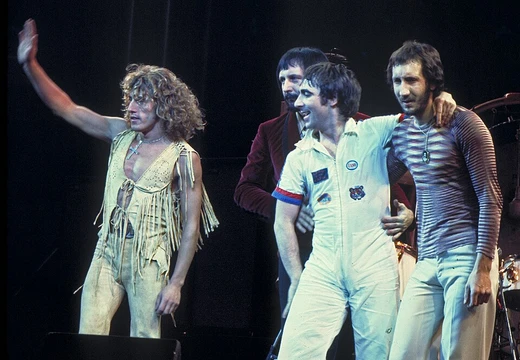
My Generation
One word, one silence, one generation's middle finger to the whole world.

My Generation is the song that announced The Who to the world. Written by Pete Townshend and released in 1965 as the title track of the band's debut album, it crystallized the Mod-era teenage defiance that would define the group's identity for decades. With its driving, windmill-strummed guitar, Roger Daltrey's snarling vocal delivery, and a chorus built around a single, defiant word followed by an abrupt silence, it became the sonic signature of a generation that refused to be told its place.
In the broader narrative of The Who's mythology, My Generation is the origin point—the moment a four-piece from Acton became a cultural force. Every subsequent album, every rock opera, every stadium-shaking encore traces its lineage back to this track. It is the song fans cite when they explain why The Who mattered, and it remains a rite of passage in any live set, a moment where the crowd's roar becomes indistinguishable from the band's own energy.
- Song by
- The Who
- Written by
- Pete Townshend
- Album
- My Generation (1965)
- Theme
- Teenage rebellion and anti-authority
- Iconic element
- The censored 'I hate' line and its broadcast silence
- Era
- British Invasion / Mod movement
Lore & Background
The song emerged from the Mod scene's simmering frustration with a post-war Britain that still expected its young people to be deferential, quiet, and grateful. Townshend, then a teenager himself, channeled that collective irritation into a tight, propulsive track where the guitar doesn't so much accompany the vocal as argue with it. The structure is deceptively simple—verses that build, a chorus that detonates—but the emotional payload is enormous. It is a song about being told you don't exist, and answering back.
The most famous moment in the track's history is the one the BBC tried to erase. The chorus's pivotal line, in which the singer declares his hatred for the older generation, was deemed too inflammatory for British radio. Broadcasters would cut in after the word 'I hate' and let a beat of dead air hang before the music resumed. That silence became more powerful than any lyric could have been; it turned a censorship event into a cultural symbol. Teenagers across the country recognized the gap as their own unspoken fury, and the song's legend grew precisely because of what was taken from it.
Musically, the track is a masterclass in economy. Townshend's windmill strumming—half-picked, half-struck—creates a chugging, percussive engine that makes the song feel like a marching order rather than a melody. Daltrey's vocal sits slightly behind the beat, as if he's shouting over the noise rather than singing into a microphone. Entwistle's bass locks to the kick drum, and Moon's kit provides the chaos at the edges. Together they built a sound that was less a genre than an attitude, and My Generation is the purest distillation of it.
In Their Own Story
The rehearsal room in Acton smelled of solder and cheap cigarettes. Pete had just strummed the chorus for the fourth time, and the silence after the word hit the air like a slap. Roger leaned into the mic and said, 'That's it. That's the whole thing. They'll cut it, and the silence will be the loudest part.' Keith, upside down on the kit, laughed. John nodded, already tuning his bass to the low E. Outside, the rain was doing what rain does in London, and somewhere a parent was telling a child to be quiet, to be grateful, to know their place. Pete picked up the capo, shifted the key, and played it again. The silence came back. It was perfect. They never changed it.
Reader's Guide
Legend: The BBC Silence. 1965. The moment the chorus hit the airwaves, the broadcaster cut the feed after the singer's declaration of hatred, leaving a beat of pure, ringing silence before the music resumed. Fans passed this down as proof that the song was too dangerous for the establishment to air whole. The silence became a shared secret, a nod in the crowd, a reason the track felt like an act of collective defiance every time it played. It turned a regulatory decision into the song's most memorable feature.
Fact: The windmill strum. From the very first live sets, Pete's half-pick, half-strum technique turned the guitar into a percussion instrument. Audiences in small London clubs would feel the floor vibrate. This wasn't a studio trick; it was the physical, sweaty, in-your-face way the band communicated. Fans who caught an early show in '65 or '66 carried that feeling for the rest of their lives, and it became the baseline against which every subsequent Who performance was measured.
Legend: The Mod anthem. In the tight-knit Mod scene of mid-60s London, My Generation wasn't just a song you played at a dance; it was the sound you played when you wanted the room to know where you stood. The tail-coat-and-Parkas crowd would stand in a tight circle, and when the chorus hit, the whole circle would sway in unison. That image—youth as a single, synchronized body—became the visual shorthand for the era, and the song remains its soundtrack.
Did You Know?
- The BBC's decision to cut the chorus's key line created a beat of broadcast silence that fans still reference as the song's most powerful moment, a silence that became more iconic than any lyric.
- Pete Townshend's windmill strumming technique, visible from the earliest live performances, turned the electric guitar into a percussive, almost physical force, setting the template for the band's stagecraft.
- My Generation served as the title track for The Who's debut album in both the UK and US, making it the song that introduced the band's name and identity to record buyers worldwide.
- The song's structure—building verses, a sharp chorus, and an abrupt stop—became a template Townshend revisited throughout the band's catalog, from 'I Can't Explain' to the rock-opera finales.
More in Lore & Legacy
Elsewhere in the The Who universe
Spotted an error? Know more?
This is a living reference — every entry is fact-audited, and reader corrections feed straight into our audit queue. Suggest an edit · See this site's audit record