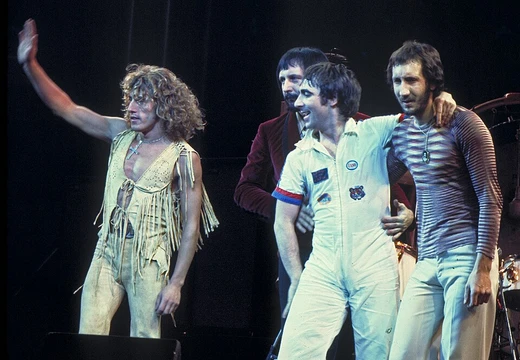
The Tommy Rock-Opera Period
A deaf, dumb, and blind boy becomes the world's most dangerous pinball champion — and The Who become the world's loudest storytellers.

The Tommy Rock-Opera Period is the era in The Who's history defined by Pete Townshend's ambitious concept album Tommy (1969) and its eventual cinematic adaptation (1975). It represents the band's boldest leap beyond the mod-rock and power-pop formulas that had made them famous, transforming a four-piece working-class band from London into the architects of a full narrative rock opera. For fans, this window is where The Who stopped being 'just a band' and became storytellers, philosophers, and spectacle-makers in equal measure.
Spanning roughly 1969 through the mid-1970s, this period bookends the band's most commercially and creatively turbulent years. It is the era of the pinball wizard, the acid queen, the corporate media machine, and the boy who could finally 'see.' It is also the era of Keith Moon's legendary destructive drumming, Roger Daltrey's operatic howling, and a live show that was less a concert and more a controlled demolition.
- Album
- Tommy (1969)
- Film
- Tommy (1975, dir. Ken Russell)
- Primary writer
- Pete Townshend
- Band lineup
- Roger Daltrey, Pete Townshend, John Entwistle, Keith Moon
- Genre
- Rock opera / progressive rock
- Cultural landmark
- First major British rock opera to achieve global commercial success
Lore & Background
At its heart, Tommy is a parable about a child stripped of every sense and then handed back a single, hyper-focused talent: the ability to play pinball with supernatural precision. Townshend built the narrative around the idea that a society which cannot accommodate a difference will either exploit it or destroy it. The boy is discovered, packaged, marketed, and ultimately consumed by the very machine that made him famous. The 'cure' he receives at the story's climax is not a medical miracle but a moment of self-recognition — he chooses to open his eyes, ears, and mouth on his own terms.
The musical architecture of the period reflects this narrative ambition. Townshend wrote songs that function as distinct dramatic scenes: a lullaby, a press conference, a courtroom, a drug-fuelled hallucination, a stadium chant. Entwistle's bass lines carry the weight of orchestral swells; Moon's drumming provides the percussive violence of a world in chaos; Daltrey's voice stretches from whispered vulnerability to a full-throated scream that could shatter glass. Together they created a vocabulary that no single rock band had attempted before.
Culturally, the period placed The Who at the intersection of counterculture, commercial pop, and theatrical spectacle. The live shows became rituals — audiences expected pyrotechnics, amp explosions, and Moon's habit of literally breaking his kit. The band was simultaneously revered as artists and reviled as troublemakers, a duality that defined their public image for the rest of their career.
In Their Own Story
The arena smells of sweat and ozone. Thousands of faces glow in the half-dark, mouths open, waiting. The lights die. A single spotlight finds a boy in a white suit, standing motionless at the center of the stage, eyes closed, hands resting on a pinball machine as if it were a cathedral altar. The silence holds for three seconds — four — five — and then the first chord hits like a fist through a window. The crowd roars. The boy's fingers find the flippers. The ball arcs, bounces, screams off the bumpers in a rhythm that is almost language. Somewhere in the back row, a teenager feels the bass in his sternum and understands, for the first time, that music can be a story you are inside. The lights come up. The boy opens his eyes. He sees them all. And they see him. And nothing in the building is the same.
Reader's Guide
The Tommy Rock-Opera Period (1969–mid-1970s) is the window in which The Who — Roger Daltrey on vocals, Pete Townshend on guitar, John Entwistle on bass, and Keith Moon on drums — transformed from a mod-era rock band into the creators of a full narrative rock opera. The sound is heavier, more theatrical, and more deliberately structured than the mod-pop of 1965–66: Townshend's power chords become dramatic punctuation, Entwistle's bass lines carry melodic weight, Moon's drumming is percussive chaos, and Daltrey's voice ranges from a child's whisper to a stadium-shaking belt.
The period is bookended by two defining moments. At its start, the 1969 release of the Tommy album established The Who as artists capable of sustained narrative ambition, with tracks like 'Pinball Wizard' and 'Do You Think It's Alright?' becoming instant cultural touchstones. At its close, the 1975 Ken Russell film Tommy translated the story into a visual spectacle, introducing the narrative to a new generation and cementing the band's place in rock mythology.
Between those poles, the live shows became legendary. The band's reputation for destructive stage behavior — Moon shattering his drum kit, Townshend smashing his guitar, amps blown into splinters — turned every concert into an event that blurred the line between performance and controlled demolition. For a new fan, this era is the spine: understand Tommy, and you understand why The Who were never just 'a band that played songs.' They were building a world, one chord at a time.
Did You Know?
- Pete Townshend has described the Tommy concept as being partly inspired by a book he read about a child who was deaf, dumb, and blind, though he has also cited influences from his own childhood experiences and the broade
- The 1975 Tommy film was not a straightforward musical; director Ken Russell used expressionistic, almost surrealist visual techniques — including a sequence where the band performs in a desert — to externalize the story'
- Keith Moon's drumming during the Tommy-era live shows was so physically violent that he frequently broke his kit mid-performance, and the band would simply continue playing with whatever remained, turning destruction int
- The story's central metaphor — a child whose single extraordinary talent is exploited by a corporate machine — has been read by fans and critics as a pointed commentary on the music industry itself, making the rock opera
More in Eras & Timeline
Elsewhere in the The Who universe
Spotted an error? Know more?
This is a living reference — every entry is fact-audited, and reader corrections feed straight into our audit queue. Suggest an edit · See this site's audit record