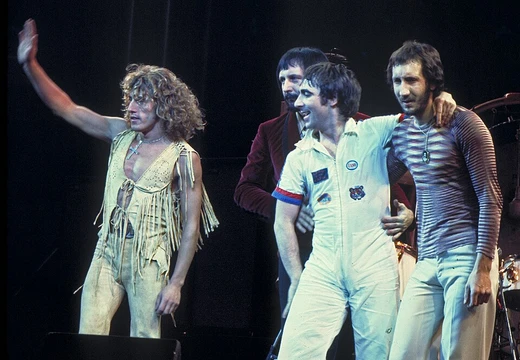
The Quadrophenia Peak
Four men, one mod's unraveling, and the loudest two years rock ever had.

The Quadrophenia Peak refers to the brief, incandescent window in The Who's career—roughly 1971 to 1974—when the band channeled the ambition of their earlier rock opera Tommy into a more personal, socially textured narrative. At its center stands Quadrophenia, the 1973 double album that follows the fracturing psyche of Jimmy Caulfield, a mod teenager whose obsession with his own subculture ultimately unravels him. For fans, this era represents the band at maximum creative density: four musicians pushing rock music toward symphonic scope while keeping the raw, backbeat-driven energy that made them a stadium act.
Culturally, the period sits at the crossroads of late-60s counterculture and the early-70s studio revolution. The Who had already proven they could fill arenas with theatrical spectacle, and Quadrophenia let them do it with a story that felt intimate and specific rather than mythic. The 1973–74 tour that followed became a rite of passage for a generation of fans, and the album's mod aesthetic—scooters, parkas, the geometry of 1960s London—gave the era a visual identity as sharp as its sound.
- Album at the core
- Quadrophenia (1973)
- Band members
- Roger Daltrey, Pete Townshend, John Entwistle, Keith Moon
- Genre
- Rock opera / progressive rock
- Central character
- Jimmy Caulfield (mod teenager)
- Predecessor rock opera
- Tommy (1969)
- Defining live era
- 1973–74 Quadrophenia tour
Lore & Background
The story of Quadrophenia is, at its heart, about the collision between identity and self. Jimmy Caulfield is a boy who has built his entire sense of self around the mod subculture—its fashion, its music, its codes of style and loyalty. The band, through Townshend's writing, peels that identity back layer by layer. The record opens with the precise, almost clinical ticking of '5:15' and closes with the desperate, spiraling chaos of 'Bell Boy,' and in between, Jimmy tries every escape hatch the mod world offers: the scooter, the pill, the sea, the church. Each one fails. The lore fans carry from this era is that the mod is not a tribe but a mirror, and looking too long into it shatters the glass.
Musically, the band treated the album as a single organism. Entwistle's bass lines carry harmonic weight that would be unusual for a rock band of the period, Moon's drumming shifts from staccato precision to thunderous fills, and Daltrey's vocal delivery ranges from whispered confessional to full-throated wail. The orchestral arrangements, layered in the studio, give the record a cinematic breadth that the live shows translated into pyrotechnic, stage-filling spectacle. The 'Ballroom' sequence, in particular, became a set-piece that audiences still reference decades later.
The cultural lore extends beyond the music. The mod revival that the album sparked—scooter clubs, parka-wearing youth, the aesthetic of 1964 London transplanted into the 1970s and beyond—gave the era a visual language that outlived the band's own peak. For fans who grew up on the record, Quadrophenia is not just an album; it is a time machine to a London that may have been more imagined than real, and that is precisely what makes it endure.
In Their Own Story
The rain had been falling on the South London terraces all afternoon, and Jimmy stood at the window of the flat, watching the water trace silver lines down the glass. The mod's head was a storm of competing signals: the need to be seen, the terror of being seen, the pill in his pocket that promised silence and the scooter in the yard that promised speed. He pressed his forehead to the cold pane. Somewhere below, a band was tuning up in a cellar—four voices, four instruments, a wall of sound that turned the whole street into a drum. He could feel it in his teeth, in the fillings, in the small bones of his wrists. He was twenty years old and he was already a ghost of himself, and the music was the only thing that made the ghost solid. He put on the parka. He walked to the cellar door. The noise swallowed him whole, and for one perfect, terrible moment, he was nobody at all, and that was the closest he would ever come to peace.
Reader's Guide
The Quadrophenia Peak (1971–1974). By 1971, The Who had already outgrown the mod-and-skiffle roots that made them a 1960s phenomenon. Who's Next had stripped their sound down to a muscular, interlocking four-piece groove, and the band was touring to arenas that dwarfed anything rock had seen before. Then Pete Townshend turned his attention to a new story: not a blind, deaf, dumb prophet, but a kid in a parka who just wanted to fit in. The result, Quadrophenia, arrived in 1973 and redefined what a rock album could be in scope and emotional specificity.
The lineup was unchanged—Daltrey's voice, Townshend's guitar, Entwistle's bass, Moon's drums—but the writing was denser, more orchestrated, more willing to let a single track breathe for ten minutes or more. The sound was still fundamentally a rock band's sound, but dressed in strings, in layered harmonies, in the kind of dynamic range that made a quiet verse hit harder than a loud chorus. Culturally, the band sat at the top of the food chain: stadium fillers, television fixtures, and now the architects of a subcultural revival that would outlast them.
Two moments bookend the era. The release of Quadrophenia in late 1973 gave the band a narrative anchor that unified their live shows into a single, escalating story. The 1973–74 tour that followed turned that story into a nightly spectacle—pyrotechnics, a full stage set, and Moon's drum kit treated as a percussion arsenal. By the time the tour wound down in 1974, the band had exhausted the immediate creative surge, and the long, difficult years of the mid-to-late seventies were already on the horizon. But for those two years, The Who were, by any measure, at the absolute summit of what four musicians could do with a guitar, a bass, a drum kit, and a voice.
Did You Know?
- Quadrophenia's mod aesthetic—parkas, scooters, the geometry of 1960s London—sparked a genuine subcultural revival that continued well into the 1980s and beyond, outlasting the band's own commercial peak.
- John Entwistle's bass work on the album is widely regarded by bassists and critics as one of the most demanding and harmonically complex in rock history, often cited as a benchmark for the instrument.
- The 1973–74 Quadrophenia tour featured an elaborate stage production with pyrotechnics and a full set design, making it one of the first rock shows to rival theatrical spectacle in scale.
- Pete Townshend has described the mod subculture at the album's center as a lens for examining how any identity, when taken to an absolute, can become a prison rather than a home.
More in Eras & Timeline
Elsewhere in the The Who universe
Spotted an error? Know more?
This is a living reference — every entry is fact-audited, and reader corrections feed straight into our audit queue. Suggest an edit · See this site's audit record