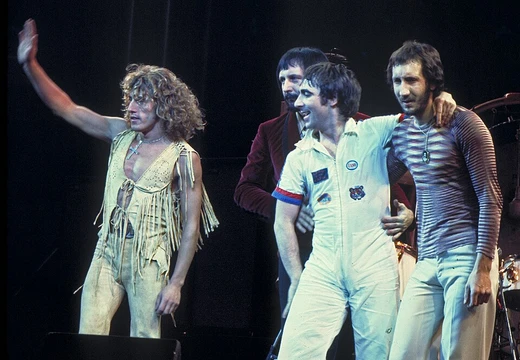
Pete Townshend
Co-founder, guitarist, keyboardist, second lead vocalist, and principal songwriter of the Who; author of two rock operas and more than 100 solo songs.

via Wikipedia: Pete Townshend · see source
Peter Dennis Blandford Townshend (born 19 May 1945) is an English musician and songwriter. He is the co-founder, guitarist, keyboardist, second lead vocalist, and principal songwriter of the Who, one of the most influential rock bands of the 1960s and 1970s. His aggressive playing style, poetic songwriting techniques and authorship of two rock operas with the Who, as well as other projects, have earned him critical acclaim. Townshend has written more than 100 songs for 12 of the Who's studio albums, including the rock operas Tommy (1969) and Quadrophenia (1973), plus popular rock radio staples such as Who's Next (1971). He has also written more than 100 songs that have appeared on his solo albums, as well as radio jingles and television theme songs. While known primarily as a guitarist, Townshend also plays keyboards, banjo, accordion, harmonica, ukulele, mandolin, violin, synthesiser, bass guitar, and drums; he is self-taught on all of these instruments. Townshend has also contributed to and authored many newspaper and magazine articles, book reviews, essays, books, and scripts, and he has collaborated as a lyricist and composer for many other musical acts.
- Role
- Co-founder, guitarist, keyboardist, second lead vocalist, and principal songwrit
- Affiliation
- The Who (1964–present); solo career; various newspaper and magazine articles, bo
- First appears
- The Who, 1964, London
- Status
- Active
- Notable non-music work
- Author of many newspaper and magazine articles, book reviews, essays, books, and
Verified Timeline
Lore & Background
Townshend was born in Isleworth, West London, at the West Middlesex Hospital, in England. He came from a musical family: his father, Cliff Townshend, was a professional alto saxophonist in the Royal Air Force's dance band the Squadronaires and his mother, Betty (née Dennis), was a singer with the Sidney Torch and Les Douglass Orchestras. The Townshends had a volatile marriage; both drank heavily and had fiery tempers. When Townshend was a toddler his parents split and he was sent to live with his maternal grandmother Emma Dennis, whom Pete later described as 'clinically insane', later citing this experience as having unknowingly influenced the plot of Tommy. The two-year separation ended when Cliff and Betty purchased a house together on Woodgrange Avenue in Acton. His neighbourhood was one-third Polish, and a devout Jewish family upstairs shared their housing with them and cooking with them — many of his father's closest friends were Jewish. Townshend says he did not have many friends growing up, so he spent much of his boyhood reading adventure novels like Gulliver's Travels and Treasure Island. It was on a trip to the seaside in the summer of 1956 that he repeatedly watched the 1956 film Rock Around the Clock, sparking his fascination with American rock and roll. Not long thereafter, he went to see Bill Haley perform in London, Townshend's first concert. At the time, he did not see himself pursuing a career as a professional musician; instead, he wanted to become a journalist. Upon passing the eleven-plus exam, Townshend was enrolled at Acton County Grammar School, where he was frequently bullied because he had a large nose. His mother purchased his first guitar for Christmas in 1956, an inexpensive Spanish model. Though his father taught him a couple of chords, Townshend was largely self-taught on the instrument and never learned to read music. Townshend and school friends formed a band in the early 1960s, and after a few name changes they settled on the Who. In June 1964, during a performance at the Railway Hotel in Harrow and Wealdstone, Townshend accidentally broke the top of his guitar on a low ceiling, an incident that would become a signature part of his stage act.
In Their Own Story
In late 1961, John Entwistle joined the Detours, a skiffle/rock and roll band led by Roger Daltrey. The new bass player then suggested Townshend join as an additional guitarist. In the early days of the Detours, the band's repertoire consisted of instrumentals by the Shadows and the Ventures, as well as pop and trad jazz covers. Their lineup coalesced around Roger Daltrey on rhythm guitar, Townshend on lead guitar, Entwistle on bass, Doug Sandom on drums, and Colin Dawson as vocalist. Daltrey was considered the leader of the group and, according to Townshend, 'ran things the way he wanted them'. Dawson quit in 1962 after arguing too much with Daltrey, who subsequently became lead vocalist. As a result, Townshend, with Entwistle's encouragement, became the sole guitarist. Through Townshend's mother, the group obtained a management contract with local promoter Robert Druce, who started booking the band as a support act for bands including Screaming Lord Sutch, Cliff Bennett and the Rebel Rousers, Shane Fenton and the Fentones, and Johnny Kidd and the Pirates. In 1963, Townshend's father arranged an amateur recording of 'It Was You', the first song his son ever wrote. The Detours became aware of a group of the same name in February 1964, forcing them to change their name. Townshend's roommate Richard Barnes came up with 'The Who', and Daltrey decided it was the best choice. Not long after the name change, drummer Doug Sandom was replaced by Keith Moon. The band was soon taken on by a mod publicist named Peter Meaden who convinced them to change their name to the High Numbers. After bringing out one failed single ('I'm the Face'/'Zoot Suit'), they dropped Meaden and were signed by two new managers, Chris Stamp and Kit Lambert. The band dropped the High Numbers name, reverting to the Who. In June 1964, during a performance at the Railway Tavern, Townshend accidentally broke the top of his guitar on the low ceiling and proceeded to destroy the entire instrument. The on-stage destruction of instruments soon became a regular part of the Who's live shows. With the assistance of Lambert, the Who caught the ear of American record producer Shel Talmy, who had the band signed to a recording contract. Townshend wrote a song, 'I Can't Explain', as a deliberate sound-alike of the Kinks. Released as a single in January 1965, 'I Can't Explain' was the Who's first hit, reaching number eight on the British charts. A follow-up single, 'Anyway, Anyhow, Anywhere', credited to both Townshend and Daltrey, also reached the top 10 in the UK. However, it was the release of the Who's third single, 'My Generation', in November that, according to Who biographer Mark Wilkerson, 'cemented their reputation as a hard-nosed band who reflected the feelings of thousands of pissed-off adolescents at the time.' The Townshend-penned single reached number two on the UK charts, becoming the Who's biggest hit. The song and its famous line 'I hope I die before I get old' was 'very much about trying to find a place in society', Townshend stated in an interview with David Fricke. To capitalise on their recent single success, the Who's debut album, My Generation (The Who Sings My Generation in the US), was released in late 1965, containing original material written by Townshend and several James Brown covers that Daltrey favoured. Townshend continued to write several successful singles for the band, including 'Pictures of Lily', 'Substitute', 'I'm a Boy', and 'Happy Jack'. Lambert encouraged Townshend to write longer pieces of music for the next album, which became 'A Quick One, While He's Away'. The album was subsequently titled A Quick One and reached No. 4 in the charts upon its release in December 1966. In their stage shows, Townshend developed a guitar stunt in which he would swing his right arm against the guitar strings in a style reminiscent of the vanes of a windmill. He developed this style after watching Rolling Stones guitarist Keith Richards warm up before a show. The Who commenced their first US tour on 22 March 1967. Townshend took to trashing his hotel suites, though not to the extent of his bandmate.
Reader's Guide
Solo recordings: Townshend has written more than 100 songs that have appeared on his solo albums, as well as radio jingles and television theme songs. He plays all instruments on his own solo albums, several Who albums, and as a guest contributor to an array of other artists' recordings. Rock operas: Townshend authored two rock operas with the Who: Tommy (1969) and Quadrophenia (1973). He has also written more than 100 songs for 12 of the Who's studio albums, including concept albums and popular rock radio staples such as Who's Next (1971), plus dozens more that appeared as non-album singles, bonus tracks on reissues, and tracks on rarities compilation albums such as Odds & Sods (1974). Writing and journalism: Townshend has contributed to and authored many newspaper and magazine articles, book reviews, essays, books, and scripts, and he has collaborated as a lyricist and composer for many other musical acts. Awards and recognition: In 1983, Townshend received the Brit Award for Lifetime Achievement and in 1990 he was inducted into the Rock and Roll Hall of Fame as a member of the Who. Townshend was ranked No. 3 in Dave Marsh's 1994 list of Best Guitarists in The New Book of Rock Lists. In 2001, he received a Grammy Lifetime Achievement Award as a member of the Who; and in 2008 he received Kennedy Center Honors. He was ranked No. 10 in Gibson.com's 2011 list of the top 50 guitarists, and No. 37 on Rolling Stone's 2023 list of 250 greatest guitarists of all time. He and Roger Daltrey received The George and Ira Gershwin Award for Lifetime Musical Achievement at UCLA on 21 May 2016.
Did You Know?
- Townshend's grandmother Emma purchased his first guitar for Christmas in 1956, an inexpensive Spanish model, and he was largely self-taught, never learning to read music.
- In June 1964, during a performance at the Railway Tavern, Townshend accidentally broke the top of his guitar on the low ceiling and proceeded to destroy the entire instrument, which soon became a regular part of the Who's live shows.
- Townshend developed his windmill guitar stunt after watching Rolling Stones guitarist Keith Richards warm up before a show.
- Townshend's first concert was seeing Bill Haley perform in London, and at the time he wanted to become a journalist, not a professional musician.
- Townshend studied graphic design at Ealing Art College alongside future Rolling Stones guitarist Ronnie Wood, and dropped out in 1964 to focus on music full-time.
More in Side Projects & Collaborations
Elsewhere in the The Who universe
Spotted an error? Know more?
This is a living reference — every entry is fact-audited, and reader corrections feed straight into our audit queue. Suggest an edit · See this site's audit record