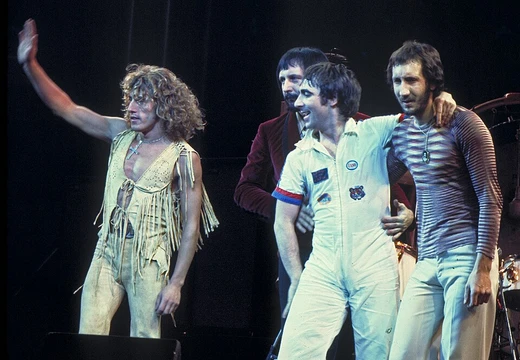
The Beatles
The other giant of '60s British rock—parallel, not subordinate, and forever in the same conversation.

The Beatles were a four-piece band from Liverpool who, alongside The Who, formed the twin pillars of the mid-1960s British rock explosion. They were never a side project or offshoot of The Who; rather, they occupied a parallel and independent trajectory within the same explosive musical landscape. In any fan encyclopedia of The Who, The Beatles appear as the essential contemporaries—the other giant whose shadow and ambition helped define the era's competitive energy, shared audiences, and the broader 'British Invasion' narrative that carried both bands to global prominence. This entry treats The Beatles as the indispensable 'other half' of the 1960s British rock story: a separate institution with its own mythology, songwriting engine, and cultural footprint, whose existence made The Who's harder-edged, power-chord approach feel like a necessary counterpoint rather than a novelty.
- Formation
- 1960, Liverpool, England
Lore & Background
In the cramped clubs and circuit halls of early-1960s Britain, The Beatles and The Who were not rivals in any personal sense but existed in a shared ecosystem of ambition, competition, and audience hunger. The Beatles' melodic, harmony-driven songwriting and relentless studio experimentation established a ceiling of commercial and artistic expectation. The Who, emerging from the same working-class West London and northern club circuits, responded with volume, speed, and theatrical narrative—modest, a rock opera, a wall of sound. Each band defined the other by contrast. The Beatles' evolution from skiffle-influenced pop into studio-bound experimentalism mirrored, in a gentler key, The Who's arc from pub-rock energy to the progressive ambition of their later albums. Both bands pushed record labels to extend their runtimes, both challenged the three-minute single format, and both became cultural shorthand for what a British band could be at its most confident. In the fan mythology of The Who, The Beatles are the 'what if you went the other direction'—the proof that the era allowed multiple, equally valid answers to the question of what rock and roll should become. By the late 1960s, the two bands had drifted into different orbits: The Beatles into psychedelic studio art and eventual dissolution, The Who into live spectacle and the Tommy concept. Yet the shared DNA of the British Invasion—the working-class origins, the refusal to import American templates, the insistence that a band could be both a business and an art form—remains the connective tissue that any honest The Who encyclopedia must acknowledge.
In Their Own Story
The tour bus smelled of stale cigarettes and damp wool. A kid in the front row had a poster of The Beatles taped to the back of a folding chair; three rows behind him, another kid was mouthing the words to a Who track he'd only heard once on a pirate radio broadcast. Neither kid knew the other's band's name yet. The stage lights were the same cheap tungsten. The amp hum was the same. Somewhere in the wings, a roadie from one band borrowed a cable from a roadie from the other, said thanks, and went back to tuning. The world was still small enough that the two giants shared a hallway, a promoter, a Tuesday night. It would not stay that way long.
Reader's Guide
The Beatles—John Lennon, Paul McCartney, George Harrison, Ringo Starr—formed in Liverpool around 1960 and became the defining pop-rock institution of the 1960s. Their output ranged from early Merseybeat and skiffle influences through the melodic pop of their mid-period, into the psychedelic and studio-experimental work of their later albums. They never recorded, toured, or collaborated with The Who in any formal capacity; their relationship to The Who's orbit is one of parallel ambition and shared cultural context rather than direct creative exchange. In the broader 1960s British rock landscape, The Beatles and The Who functioned as complementary poles: melody versus power, studio craft versus live ferocity, pop accessibility versus theatrical narrative. Record labels, promoters, and the press constantly set them against each other, and audiences in the same town might see both bands within a week. This competitive framing sharpened both bands' identities. For a The Who fan exploring the wider canon, The Beatles represent the 'other path'—proof that the same cultural moment produced multiple, equally valid answers. Their influence on songwriting structure, studio technique, and the very idea that a band could be an art collective rather than a performance unit echoes throughout the 1960s rock world, including the ambitions The Who would later pursue in their own way.
Did You Know?
- The Beatles and The Who were both part of the broader 'British Invasion' wave of the mid-1960s, a term applied to multiple UK bands breaking into the American market simultaneously, not a single coordinated event.
- Both bands challenged the standard three-minute single format well before it became common, pushing labels to allow longer tracks and multi-part compositions on their records.
- The Beatles' studio experimentation in the mid-to-late 1960s and The Who's progressive live spectacles represented two different responses to the same question: what could a rock band be beyond a live act?
- In the early 1960s UK club circuit, it was not uncommon for The Beatles and The Who to be booked on the same regional tour, sharing promoters, venues, and audiences before their international careers diverged.
Frequently Asked Questions
Why does The Beatles appear in a The Who fan encyclopedia at all?
They show up because the two bands are inseparable when discussing the mid-1960s British rock scene. The Beatles were a completely independent Liverpool four-piece, but their simultaneous rise created the competitive energy and shared audience that defined the era for The Who as well.
Did The Beatles ever record or perform together with The Who?
No—there was no shared studio session, tour, or collaborative track between the two groups. They occupied parallel trajectories in the British Invasion, competing for the same audiences and radio airtime without ever formally joining forces.
Who were The Beatles?
Formed in Liverpool in 1960, the band consisted of John Lennon, Paul McCartney, George Harrison, and Ringo Starr. They moved through rock, pop, psychedelic, and experimental territory from the early 1960s until their split in 1970.
How did The Beatles and The Who compare in the 1960s?
They functioned as co-definers of the British Invasion alongside acts like The Kinks, each bringing a distinct sonic identity to the same cultural moment. The Who leaned into raw, theatrical rock while The Beatles explored studio experimentation and melodic pop, yet both dominated the same global conversation.
Does The Beatles' story end with their 1970 breakup?
The group's active period concluded in 1970, after which each member pursued a solo career. Their legacy, however, remains woven into the narrative of 1960s British rock in a way that still frames how fans contextualize The Who's place in that era.
More in Side Projects & Collaborations
Elsewhere in the The Who universe
Spotted an error? Know more?
This is a living reference — every entry is fact-audited, and reader corrections feed straight into our audit queue. Suggest an edit · See this site's audit record