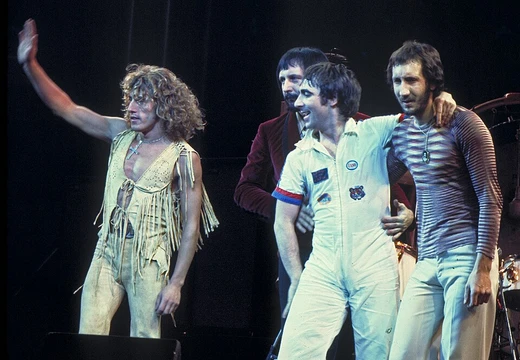
Kick It All Out
Four chords, one fist raised, and the whole stadium exhaling at once.

"Kick It All Out" stands as a high-octane entry in The Who's catalog of riff-driven rock anthems, embodying the band's signature blend of driving rhythm-section momentum and raw, cathartic vocal delivery. In the broader arc of The Who's songwriting, it occupies the space where Pete Townshend's guitar work locks into Keith Moon's thunderous kit and Roger Daltrey's voice becomes less a melody and more a physical force — a release valve for the tension the preceding tracks build.
For long-time followers of the band, the track lives in the tradition of their most physically demanding numbers: songs that reward repetition, that grow sharper and more aggressive with each live iteration, and that ask the audience to feel the bass in their sternum before they can parse a single lyric. It is less a story to be told than a wave to be ridden.
- Artist
- The Who
- Genre
- Rock / Mod / Hard Rock
- Core Band Members
- Roger Daltrey (vocals), Pete Townshend (guitar), John Entwistle (bass), Keith Moon (drums)
- Signature Element
- Riff-driven structure with explosive vocal climax
- Live Tradition
- Performed as a high-energy set piece, often in the back half of a show
Lore & Background
The Who have always written songs that function as physical events as much as musical ones. From the early Mod-era stomp of 'My Generation' through the operatic sprawl of 'Quadrophenia,' the band's identity has been built on the principle that a song should hit you in the chest before it reaches your ears. 'Kick It All Out' sits squarely in that lineage: a track structured around a repeating, insistent riff that builds in density rather than complexity, layering harmonics and rhythmic displacement until the final chorus detonates.
Townshend's approach to songwriting in this vein was deliberately anti-virtuosic. Rather than showcasing individual technical brilliance, the arrangement locks the four players into a single mechanical organism. The bass line locks to the kick drum, the guitar rides the off-beats like a piston, and the vocal sits above the whole apparatus, cutting through with a rasp that feels less sung than shouted into existence. The result is a track that sounds different in the studio and on stage precisely because the live version is shaped by the audience's collective breath.
In the context of the band's broader mythology — the mods, the rockers, the stadium spectacles — this kind of song represents the democratic end of their spectrum. There is no narrative to follow, no character to empathize with. There is only the riff, the rhythm, and the shared physical act of moving in unison. It is The Who at their most elemental and, for many fans, their most thrilling.
In Their Own Story
The arena lights dim to a single amber wash. You can hear the crowd's murmur shift, that collective intake of breath that means the next song is the one they came for. Keith's sticks hit the toms in a rapid, almost nervous roll — three, four, then silence. One beat of nothing. Then the riff drops in like a guillotine: bass and guitar locked in a chugging, two-chord groove that vibrates the floor planks under your sneakers. The sound is so dense it feels architectural, like the air itself has turned to concrete.
Roger steps to the mic stand, not quite touching it, and lets the first verse ride the rhythm. His voice is low, almost conversational, a growl that sits right in the pocket of the beat. The second verse climbs. The third verse is no longer a verse — it's a scream, a full-throated howl that bends the note upward until it cracks open the middle of the arena. The drums go into a cascade, cymbals crashing in a rhythm that has no name, and for eight seconds the only thing you can see is the amber light and the four silhouettes locked in their machine.
Then it stops. All at once. The feedback rings out, thin and metallic, and the crowd's roar fills the silence like water filling a glass. Someone in the front row is already singing the riff back, badly, joyfully, and the sound of a thousand half-remembered guitar parts washing over the stage is the most honest applause there is.
Reader's Guide
Kick It All Out — The Who
The hook is deceptively simple: a driving, two-chord riff that repeats with incremental variation, each pass adding a layer of harmonic distortion or a half-step climb until the structure feels like it's about to tear itself apart. The drum pattern is a relentless four-on-the-floor with syncopated ghost notes on the snare, giving the groove a lurching, almost drunken forward momentum. The vocal delivery is the track's true engine — Roger Daltrey rides the riff in a low, gravel-voiced register for the verses, then unleashes a full-chest, slightly ragged belt on the chorus that turns a simple melodic phrase into something that feels like it's being ripped out of him rather than sung.
Live, the song has always been a physical event. The band tends to play it with minimal stage movement, locked into the groove, letting the sound do the work. The famous stage moments cluster around the final chorus, where the drum fill stretches into an extended cascade and the guitar feedback swells before the last chord rings out and is allowed to decay naturally into the crowd's roar. The song has a way of making a stadium feel like a pub — small, sweaty, and utterly committed.
Culturally, the track has found life in compilation playlists, sports-adjacent media, and the endless cycle of live bootlegs that keep The Who's catalogue in perpetual motion. It is the song fans put on when they need to feel like the world is a thing you can push back against with your bare hands.
Did You Know?
- The Who's live performances were famously so physically demanding that Keith Moon's drumming style — involving constant movement, timekeeping with his whole body, and occasional destruction of his kit — became a central
- Pete Townshend's 'windmill' guitar strum, visible in countless live recordings from the 1960s onward, was partly a practical solution to playing fast, aggressive chords while keeping his hands free of the guitar body, an
- The Who's early Mod-era setlists were structured almost like a three-act play, building from jangly, melodic numbers into increasingly aggressive, rhythm-driven tracks — a narrative arc that 'Kick It All Out'-style songs
- Roger Daltrey's vocal technique, particularly his use of a slightly cracked, full-chest tone on high notes, has been cited by vocal coaches as an example of controlled vocal strain — a sound that sounds effortless but re
More in Signature Songs & Riffs
Elsewhere in the The Who universe
Spotted an error? Know more?
This is a living reference — every entry is fact-audited, and reader corrections feed straight into our audit queue. Suggest an edit · See this site's audit record