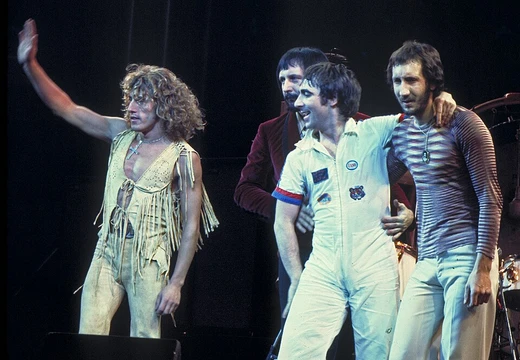
Quadrophenia Live
Four men, one mod's fever dream, and a stage that shakes the floor.

Quadrophenia Live captures The Who in the act of performing their 1973 rock opera on stage, translating the meticulously layered studio production into the raw, thunderous energy of a live concert. Where the original record is a carefully constructed journey through the mind of a young mod named Jimmy, the live version strips away the studio polish and lets the four-piece band—Daltrey, Townshend, Entwistle, Moon—collide with the material in real time, with all the glorious imperfection and physicality that only a concert can deliver.
For fans, this recording represents a rare window into how The Who treated their most ambitious work outside the studio: not as a museum piece, but as a living, breathing set of songs that could be screamed, stomped, and riffed through with the same ferocity they brought to their shorter rockers. It sits at the intersection of art-rock ambition and working-class rock-and-roll grit, which is precisely where The Who have always lived.
- Artist
- The Who (Roger Daltrey, Pete Townshend, John Entwistle, Keith Moon)
- Source material
- Quadrophenia (1973 rock opera)
- Performance venue (primary source)
- Hammersmith Odeon, London
- Performance era
- 1974
- Original studio producer
- Glyn Johns
- Genre
- Rock opera / live rock
Lore & Background
Quadrophenia was never merely an album to The Who; it was a narrative they had to *perform* in their bodies. In the studio, Glyn Johns coaxed layers of guitar, Mellotron, and orchestral texture out of the band to build Jimmy's world of mod identity, heartbreak, and existential crisis. On stage, that layered architecture collapsed into something more primal: Daltrey's voice cracking and soaring over Townshend's windmilled power chords, Entwistle's bass punching through the low end like a second heartbeat, and Moon's drums detonating in a storm of cymbals and toms that made the venue feel like it was being demolished from the inside.
The 1974 Hammersmith Odeon dates are particularly significant because they represent the band at the peak of their live stamina, performing the full opera in sequence rather than cherry-picking singles. Jimmy's journey—from the anxious, identity-obsessed mod of '5:15' through the delirious 'Bell Boy' to the exhausted, hollowed-out 'Love, Reign O'er Me'—became a two-hour emotional arc that the audience experienced in real time, without the safety net of a pause button. Townshend, who had written the story as a semi-autobiographical exploration of his own teenage restlessness, watched his characters come alive through Daltrey's delivery, and the feedback between writer and performer added a layer of spontaneity the studio version could never replicate.
What makes the live Quadrophenia recordings special in the broader canon of The Who's output is the tension between structure and chaos. The songs follow a fixed narrative order, but within each track the band stretches, repeats, and improvises. Moon's drumming, in particular, treats the opera's more delicate moments—like the whispered vulnerability of 'I'm a Heart'—as opportunities to build a slow, rolling thunder that swells beneath Daltrey's voice, turning intimacy into something almost architectural. It is rock opera as *physical* event, not just a story told in sound.
In Their Own Story
The house lights die and the Hammersmith Odeon becomes a mouth, swallowing the audience whole. A single guitar chord rings out—Townshend's, clean and cold—and for three seconds the only sound is the hum of the amps and the held breath of two thousand people. Then Moon's kick drum hits like a fist through a window, and the whole room lurches forward in its seats. Daltrey steps to the mic, his eyes half-closed, and the first syllable of Jimmy's anxious monologue spills out raw, unproduced, *human* in a way the studio version never quite was. Somewhere in the third row, a teenager in a mod jacket feels the bass note in her sternum and realizes she is not listening to a record. She is inside the story. The walls are vibrating. The night is not going to let her go.
Reader's Guide
Recorded during The Who's 1974 Hammersmith Odeon residency in London, this live set presents the full Quadrophenia rock opera as performed in concert, capturing the band at the height of their live power. Sonically, it trades the studio's layered orchestration for a four-piece wall of sound: Townshend's jangly, percussive guitar work, Entwistle's melodic bass lines cutting through the mix, Moon's relentless and inventive drumming, and Daltrey's voice ranging from whispered vulnerability to full-throated howl. What makes it a step forward from the studio original is the *physicality*—the audience noise, the ad-libs, the way the band stretches and compresses time in real time, turning a fixed narrative into a living event.
Standout moments include: '5:15' for its anxious, ticking-clock energy that sets the entire tone; 'I'm a Heart' for Daltrey's aching, almost fragile vocal delivery contrasted against Moon's rolling build; 'Bell Boy' for its delirious, double-time urgency that becomes a live spectacle; 'The Ball' for its driving, anthemic rock that turns the opera's midpoint into a stadium-sized banger; and 'Love, Reign O'er Me' for its devastating, exhausted finality that leaves the audience in a stunned silence before the encore.
Critical reception of live Quadrophenia performances of this era has generally been warm, with reviewers noting the band's commitment to performing the full narrative rather than treating it as a collection of singles. Production quirks include the natural reverb of the Odeon's acoustics, the occasional bleed of audience reaction into the mix, and the raw, uncorrected take quality that makes every performance feel singular and unrepeatable.
Did You Know?
- Pete Townshend wrote Quadrophenia partly as a way to process his own teenage restlessness and identity confusion in 1960s London, making the live performance of '5:15' a kind of public exorcism every night.
- Keith Moon was known to treat the quieter, more emotional passages of the opera as opportunities to build a slow, rolling drum crescendo that could last nearly a minute before the next section hit, turning vulnerability
- The Hammersmith Odeon, the primary venue for these 1974 performances, was a legendary London concert hall that hosted countless landmark shows and was eventually demolished in 1986, making these recordings a permanent so
- John Entwistle's bass parts on Quadrophenia are notably melodic and lead-heavy compared to his work on earlier Who albums, and in the live setting his lines often carry the harmonic backbone of a song while Townshend foc
More in Albums & Discography
Elsewhere in the The Who universe
Spotted an error? Know more?
This is a living reference — every entry is fact-audited, and reader corrections feed straight into our audit queue. Suggest an edit · See this site's audit record