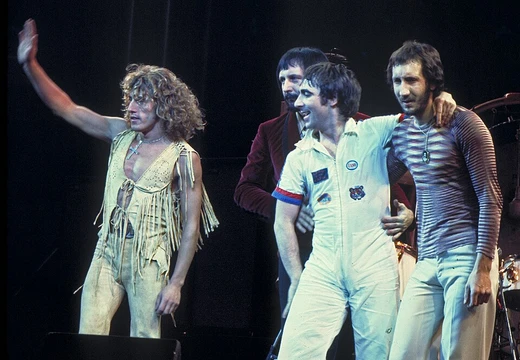
Behind Blue Eyes
A chromatic guitar wail and a crooner's plea: the cocky rock star's quiet confession.

"Behind Blue Eyes" is a 1971 single by The Who, written by Pete Townshend and performed with Roger Daltrey on lead vocals. It appeared on the band's landmark album *Who's Next* and stands as one of the group's most recognizable melodic statements—a tender, aching counterpoint to the thunderous rock that defined their reputation. What began as a quiet, introspective response to the media's caricature of the band as arrogant rock stars would, years later, become a global number-one hit and a permanent fixture of the rock canon.
The song endures because it captures a universal feeling of being misunderstood, wrapped in a deceptively simple arrangement of a chromatic guitar figure, a driving drum groove, and Daltrey's characteristically earnest, slightly wry vocal delivery. It is the track fans often point to when they say The Who could write a pop song that still felt like *them*—raw, human, and unapologetically vulnerable.
- Song
- Behind Blue Eyes
- Album
- Who's Next (1971)
- Writer
- Pete Townshend
- Lead Vocals
- Roger Daltrey
- Band
- The Who
- US Chart Peak
- #1, Billboard Hot 100 (1978 re-release)
- Genre
- Rock / Pop rock
Lore & Background
Pete Townshend has spoken in interviews about the frustration of watching the press reduce The Who to a stereotype—the loud, brash, sunglasses-wearing rock gods who didn't care. "Behind Blue Eyes" was his direct, almost defiant rebuttal: a song that says, in plain language, that beneath the stage persona there is a person who feels things, who is judged, who is lonely. The lyrics walk through a sequence of small, specific grievances—being told what to do, being seen as a symbol rather than a human—and build to a chorus that is less a declaration than a weary, half-smiling sigh.
Musically, the track sits in an interesting tension within *Who's Next*, an album otherwise packed with orchestral swells, multitracked guitar walls, and prog-ambitious structures. Here, the arrangement strips back to the essentials: a repeating descending guitar figure that feels almost like a sigh, Keith Moon's tight, insistent drum pattern that keeps the whole thing from dissolving into sentimentality, John Entwistle's bass locking in with the kick drum to create a pocket you can feel in your chest, and Daltrey singing with a slightly exasperated, almost amused tenderness that prevents the song from tipping into self-pity. It is, in the best sense, a pop song that trusts the listener to feel the weight without being told what to feel.
The song's afterlife has been extraordinary. Initially met with some skepticism by fans who expected more volume and less vulnerability, it gradually found its audience. By the late 1970s, a re-release propelled it to the top of the Billboard Hot 100, introducing a new generation to a band many knew only as stadium-rock titans. That crossover moment—hard-rock fans discovering a ballad that made them feel seen—became part of The Who's legend, proof that the band's emotional range was wider than the caricature ever allowed.
In Their Own Story
The dressing room smelled of stale beer and hairspray. Pete sat on the edge of the mirror, guitar across his lap, and played the descending figure for the fourth time that night. Roger leaned in the doorway, arms crossed, listening. "You're doing it again," Roger said, not unkindly. "Making the sad face while you play the sad face." Pete didn't look up. "It's not a sad face, Rog. It's a *tired* face." Outside, the roadies were already stacking amps for the next town. Somewhere in the back of the van, a tape recorder hummed, capturing the hum of the string, the thud of a pick against the wood. Pete played the figure one more time, let the last note ring out into the fluorescent hum, and set the guitar down. "Yeah," he said. "That's the one."
Reader's Guide
**Behind Blue Eyes** appears on *Who's Next* (1971), the album that cemented The Who's reputation as architects of large-scale rock. The track opens with its signature hook: a descending chromatic guitar figure, clean but with just enough overdrive to give it a bruised, aching edge, repeating in a hypnotic loop that feels like a heartbeat slightly out of rhythm. Keith Moon locks into a tight, almost jazz-influenced groove—kick and snare interlocking with a hi-hat shimmer that keeps the energy forward without ever exploding. John Entwistle's bass sits low and round, anchoring the pocket. Then Roger Daltrey steps in, and his delivery is the key: not belting, not shouting, but a slightly weary, half-smiling croon that makes the lyrics land as confessions rather than declarations. The chorus lifts with a simple, open chord change that gives the melody room to breathe, and Daltrey's "Behind blue eyes" lands with a gentle, almost rueful emphasis that makes the whole line feel like a sigh you didn't know you were holding.
Live, the song became a moment of contrast in otherwise explosive sets. Townshend would often step away from the wall of multitracked guitar and let the band play it almost acoustically, the four of them huddled at the front of the stage, the audience suddenly very still. The 1970s and 80s tours featured it as a mid-set breather, and the 1978 re-release that sent it to number one in the US made it a mandatory closer or penultimate track, the crowd singing along with a familiarity that belied the song's relative youth.
Culturally, the track has a long tail of film and television placements, radio airplay across decades, and covers ranging from punk reworkings to orchestral medleys. It remains one of the most requested songs in the band's live catalogue and a perennial entry point for new listeners discovering The Who beyond the stadium anthems.
Did You Know?
- Pete Townshend has described the song as a direct response to the music press's habit of portraying The Who as cocky, untouchable rock stars, and he wrote it to say, in effect, 'we are people who feel things.'
- The song first appeared as a single in 1971 but did not reach the top of the US Billboard Hot 100 until a 1978 re-release, making it one of the most notable late-charting rock hits of the era.
- Within the track listing of *Who's Next*, it sits between the sprawling, orchestral 'Bargain' and the multitracked 'Getting in Out of School,' making its comparatively sparse, intimate arrangement a deliberate contrast i
- Roger Daltrey's vocal on the track is notably more restrained and conversational than his typical rock delivery, a choice that has made the song a frequent showcase for vocal covers and tribute performances.
More in Signature Songs & Riffs
Elsewhere in the The Who universe
Spotted an error? Know more?
This is a living reference — every entry is fact-audited, and reader corrections feed straight into our audit queue. Suggest an edit · See this site's audit record