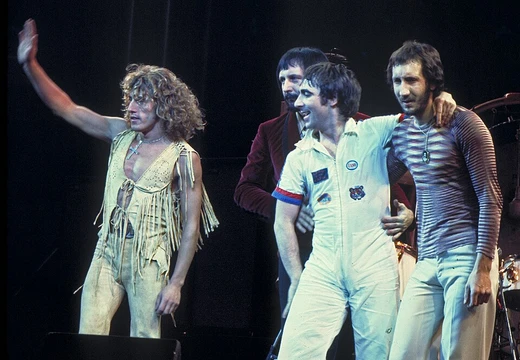
The Who: Live at the Wembley Empire Pool
Four kids, one arena, and the raw thunder of a generation still finding its voice.

The Who: Live at the Wembley Empire Pool captures the band at a formative moment in their career, performing in one of London's most iconic mid-century venues. Recorded during the height of the mod era, this live document showcases the raw, kinetic energy that made The Who a force on the British club and arena circuit before they ever stepped into a recording studio to craft a concept album. As a live recording, it occupies a special place in the band's discography: a snapshot of four young musicians in full flight, trading in the immediate electricity of a packed crowd rather than the layered production of their studio work. For fans, it's a window into the early sound—the driving rhythms, the interlocking guitar-and-bass interplay, and Daltrey's urgent vocal delivery—that would later evolve into the grander theatrical works the band is best known for.
- Type
- Live recording
- Venue
- Wembley Empire Pool, London
- Era
- Mid-1960s
- Band members
- Roger Daltrey, Pete Townshend, John Entwistle, Keith Moon
- Sonic character
- Mod-influenced rock, high-energy live performance
- Significance
- Documents the band's early live sound before their studio concept albums
Lore & Background
The Wembley Empire Pool was a cathedral of popular music in 1960s London—a vast, echoing space where the best acts in the country tested their mettle against thousands of fans. For The Who, performing there represented a rite of passage: they had climbed from small mod clubs and regional gigs to a venue that commanded national attention. The crowd in those days was young, dressed in sharp suits and parkas, and hungry for the kind of unfiltered, physical music that the band delivered night after night. What made these early live sets distinctive was their brevity and ferocity. The songs were tight, often under three minutes, and the band played them like a sprint—no wasted movement, no filler. Townshend's guitar work was already showing the angular, staccato phrasing that would become his signature, while Entwistle's bass lines locked in with Moon's drumming to create a rhythmic engine that felt almost mechanical in its precision. Daltrey sang with a desperate, almost confrontational intensity that made every lyric land like a punch. In the broader arc of The Who's story, this period represents the 'before'—the moment when they were still a band of four playing sharp, mod-inflected rock, before the ambition of Tommy, the narrative sprawl of Quadrophenia, and the theatrical spectacle of their stadium shows. Listening to a Wembley Empire Pool recording is like watching a seedling: the full-blown tree is already encoded in the DNA, but the sound is leaner, hungrier, and more immediate.
In Their Own Story
The air in the Empire Pool tasted of sweat and cheap perfume. The house lights dropped and the silence lasted only a beat before the bass kicked in—Entwistle's line cutting through the hush like a blade through wet cloth. Moon's drums answered, not a groove so much as a pulse, a heartbeat pushed past its natural limit. Townshend stood at the edge of the stage, guitar raised, waiting. Then the chord hit, and three thousand people in sharp jackets and flat caps felt the floor shift beneath their shoes. Daltrey leaned into the microphone, jaw tight, and the first word tore out of him like something ripped from a page. The crowd roared back. For the next hour, nobody breathed. Nobody needed to.
Reader's Guide
Think of this recording as a single, unbroken exhalation. The thematic arc is simple: energy in, energy out. There is no narrative, no concept, no multi-minute suite. What there is instead is a band locked in a rhythmic conversation that never lets up, each song a compact burst of mod-era rock that builds, peaks, and cuts away before you can settle in. Production-wise, the live setting does the heavy lifting. The Empire Pool's natural reverb gives the guitars a slight sheen, the drums a roomy, almost orchestral depth that a studio would have to fake. You can hear the crowd breathing between phrases, the creak of the stage, the slight bleed of one instrument into another. It's unpolished in the best way—every crack and imperfection is a fingerprint of that specific night. In the band's evolving musical universe, this sits at the origin point. The angular guitar phrasing, the interlocking bass-drum engine, the vocal urgency—all of it is here in embryonic form. Listen closely and you can hear the seeds of what will become the power chords of their later work, the theatrical vocal delivery, the rhythmic architecture of their biggest songs. It is the raw material before the alchemy.
Did You Know?
- The Wembley Empire Pool was one of the largest indoor venues in the UK during the 1960s, capable of holding thousands of fans in a single, echoing space that gave live recordings a distinctive natural reverb.
- During this era, The Who's live sets were notably short and intense, often lasting under an hour, which made their reputation for ferocious energy all the more concentrated and memorable.
- John Entwistle's bass playing in this period was already characterized by its powerful, melodic lines that functioned almost as a second guitar, a trait that would define his role in the band for decades.
- The mod fashion aesthetic of the mid-1960s crowd—sharp suits, parkas, flat caps—created a visual uniformity in the audience that made the Wembley Empire Pool shows feel like a collective, almost ritualistic experience.
More in Albums & Discography
Elsewhere in the The Who universe
Spotted an error? Know more?
This is a living reference — every entry is fact-audited, and reader corrections feed straight into our audit queue. Suggest an edit · See this site's audit record